When you sell business property at a gain, depreciation recapture sets how much is taxed at higher rates. Under Section 1245, gain on equipment is ordinary income up to the depreciation claimed. Under Section 1250, an individual's gain on a building, up to the straight-line depreciation taken, is taxed at no more than 25%. The rest falls under Section 1231.
Part 2 of the Special Enrollment Examination (SEE) tests recapture with a cost, a depreciation total, and a sale price, then asks you to sort the gain. This guide from VantageEA, an Enrolled Agent (EA) exam practice platform, covers each rule with worked examples and the traps that cost points.
What is depreciation recapture, and how does it change your gain?
Depreciation recapture taxes part of a gain as ordinary income (or, for an individual's building, at up to 25%) because the depreciation deductions already lowered ordinary income in earlier years. Recapture never adds to the gain. It only changes the character of gain that already exists.
Every problem starts with two numbers: adjusted basis (cost plus improvements, minus all depreciation and amortization allowed or allowable, including Section 179 and bonus depreciation) and the total gain or loss (amount realized minus adjusted basis). Then each rule claims its share:
| Rule | Property it covers | Gain it reaches | How that gain is taxed |
|---|---|---|---|
| Section 1245 | Equipment, vehicles, furniture, amortizable Section 197 intangibles | Gain up to all depreciation and amortization taken | Ordinary income |
| Section 1250 (individuals) | Buildings and other depreciable real property | Gain up to the straight-line depreciation taken | Unrecaptured Section 1250 gain, 25% maximum rate |
| Section 291 (C corporations) | Buildings owned by a C corporation | 20% of the lesser of the gain or the depreciation taken | Ordinary income |
| Section 1231 | Business property held more than one year | Gain left after recapture | Long-term capital gain if the year nets to a gain, ordinary loss if it nets to a loss |
IRS Publication 544, Sales and Other Dispositions of Assets, covers these rules in its chapter on the sale of business property, and the gain, loss, and recapture topic page breaks them into drills.
What counts as Section 1231 property?
Section 1231 property is real property or depreciable property used in a trade or business and held more than one year. Publication 544 treats property held for the production of rents as used in a trade or business, so rental real estate generally qualifies.
- Included: machinery, vehicles, furniture, business land and buildings, and rental real estate.
- Livestock: cattle and horses held for draft, breeding, dairy, or sporting purposes for 24 months or more, and other livestock held for those purposes for 12 months or more. Poultry does not qualify.
- Excluded: inventory and property held mainly for sale to customers, however long you hold it, and a copyright or artistic work created by your own effort.
Section 1231 gives the favorable result in both directions: capital gain treatment for a net gain and ordinary treatment for a net loss. No holding period turns inventory into Section 1231 property.
How does Section 1245 recapture work on equipment?
Section 1245 treats gain as ordinary income up to the lesser of the total gain or the depreciation and amortization taken. Gain above the original cost is Section 1231 gain. Section 1245 property includes machinery, equipment, vehicles, and amortizable Section 197 intangibles such as a purchased customer list.
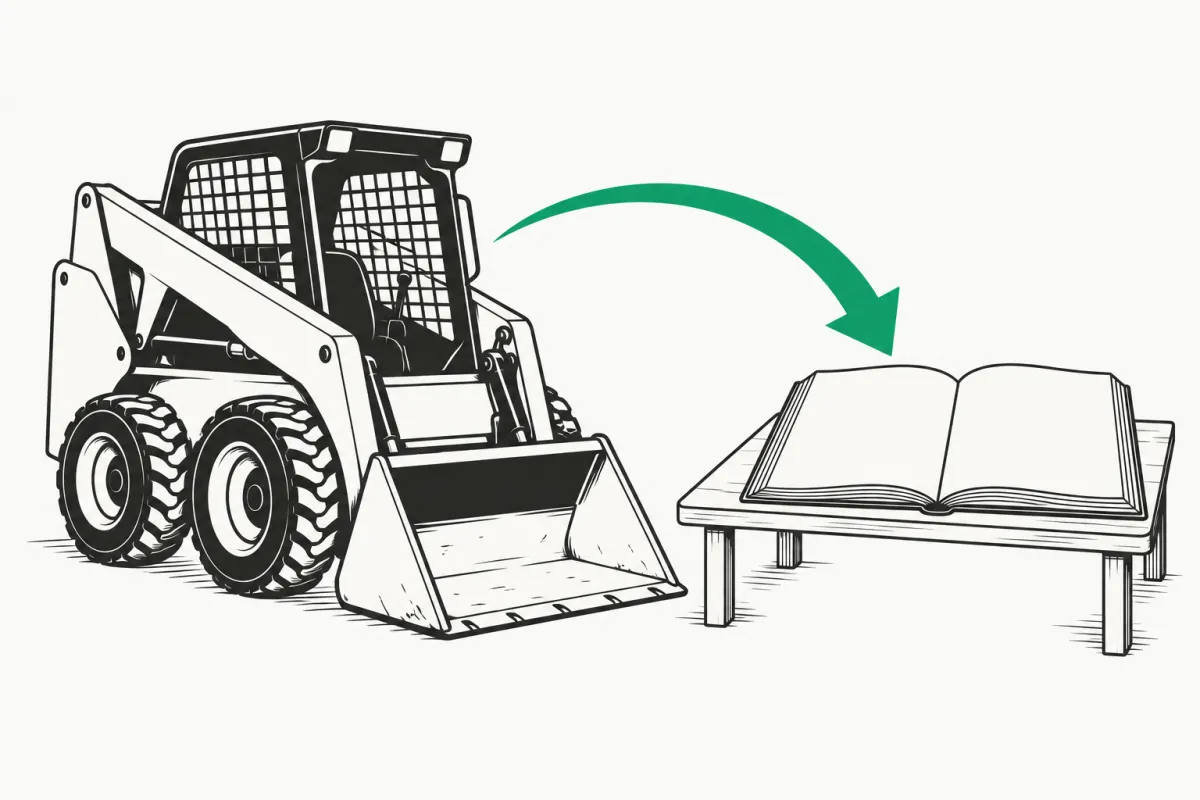
A landscaping company bought a skid steer for $64,000 and deducted $41,000 of depreciation, leaving an adjusted basis of $23,000. Here is how three possible sale prices play out:
| Sale price | Total gain or loss | Section 1245 ordinary income | Section 1231 result |
|---|---|---|---|
| $52,000 | $29,000 gain | $29,000 | None |
| $70,000 | $47,000 gain | $41,000 | $6,000 gain |
| $18,000 | $5,000 loss | None | $5,000 loss |
In the first row the gain is smaller than the depreciation, so every dollar is ordinary income. The last row is a loss, so there is nothing to recapture. Section 1245 recapture can never exceed the gain or the depreciation.
Do Section 179 and bonus depreciation get recaptured?
Yes. For recapture purposes, the Section 179 deduction and bonus depreciation count as depreciation. A fully expensed asset has a zero basis, so any sale price up to its original cost is ordinary income.
- Full expensing: a bakery expenses a $38,000 oven under Section 179 and sells it three years later for $15,000. The full $15,000 is Section 1245 ordinary income.
- Business use drops: if Section 179 property or listed property, such as a vehicle, falls to 50% business use or less before its recovery period ends, you include in income the deduction taken above the depreciation otherwise allowed, even with no sale. This goes on Form 4797, Part IV.
IRS Publication 946, How to Depreciate Property, explains both rules, and the Section 179 and MACRS interaction topic shows how expensing lowers basis. A faster write-off today means more ordinary income when you sell.
How is Section 1250 recapture different for buildings?
Section 1250 covers depreciable real property such as office buildings, warehouses, and residential rentals. Its ordinary income recapture reaches only additional depreciation, meaning depreciation above the straight-line amount. Buildings placed in service after 1986 must use straight-line MACRS (27.5 years for residential rental property, 39 years for nonresidential real property), so they rarely have any.
Individuals still pay a higher rate on the depreciation portion. Gain equal to the straight-line depreciation taken is unrecaptured Section 1250 gain, taxed at a maximum rate of 25%, and gain above it is Section 1231 gain. Suppose a consultant bought an office building for $480,000 (land left out for simplicity) and claimed $96,000 of straight-line depreciation, for an adjusted basis of $384,000:
- Sale at $530,000: a $146,000 gain, split into $96,000 of unrecaptured Section 1250 gain and $50,000 of Section 1231 gain.
- Sale at $430,000: a $46,000 gain, all unrecaptured Section 1250 gain because it is less than the depreciation.
A common wrong answer calls the $96,000 ordinary income. For an individual who used straight-line depreciation, the depreciation slice of a building gain is capped at a 25% rate.
C corporations and Section 291
C corporations pay a flat 21% rate on all income, so the 25% cap does not apply. Instead, Section 291 makes 20% of the amount Section 1245 would have recaptured, less any Section 1250 recapture, ordinary income. A C corporation selling the same building for $530,000 reports 20% of $96,000, or $19,200, as ordinary income and $126,800 as Section 1231 gain. The EA Part 2 business taxation exam tests both entity types, so check who owns the property.
How do Section 1231 netting and the five-year lookback work?
After recapture, you combine every Section 1231 gain and loss for the year. A net gain is long-term capital gain, and a net loss is an ordinary loss that avoids the $3,000 capital loss limit. Casualty and theft results on business property held more than one year are netted first. If they produce a net loss, that loss is ordinary and stays out of the main netting.
Then the lookback rule applies. A net Section 1231 gain is ordinary income to the extent of nonrecaptured net Section 1231 losses from the previous five years. Consider a rental owner with this history:
| Tax year | Section 1231 result | Tax treatment |
|---|---|---|
| 2022 | $12,000 net loss | Deducted in full as an ordinary loss |
| 2023 and 2024 | No Section 1231 sales | Nothing to report |
| 2025 | $30,000 net gain | $12,000 ordinary income and $18,000 long-term capital gain |
The lookback stops a business from taking ordinary losses one year and capital gains the next.
Where does each piece go on Form 4797?
Form 4797, Sales of Business Property, has a part for each step:
- Part III: computes Section 1245 and 1250 recapture on depreciable property sold at a gain after more than one year.
- Part II: collects ordinary gains and losses, including Part III recapture and business property held one year or less.
- Part I: nets Section 1231 gains and losses, including gain left after recapture, and applies the five-year lookback.
- Part IV: reports Section 179 and listed property recapture when business use falls to 50% or less.
A net gain from Part I flows to Schedule D, and a net loss flows to Part II as an ordinary loss. Individuals figure unrecaptured Section 1250 gain on a worksheet in the Schedule D instructions.
Does recapture apply to installment sales, gifts, and inherited property?
In most transfers, recapture either follows the asset or speeds up the tax. A transfer at death is the main exception.
- Installment sales: all recapture income is taxed in the year of sale, even if no payment arrives that year. According to IRS Publication 537, Installment Sales, only gain above the recapture amount can use the installment method.
- Gifts: a gift triggers no recapture. The recipient takes over the donor's basis and the recapture potential.
- Death: no recapture applies, and the heir's basis resets to fair market value, which erases the depreciation history.
- Related parties: under Section 1239, gain on selling property that will be depreciable in the buyer's hands to a related party, such as a corporation you own more than 50% of, is entirely ordinary income.
The guide to gift vs inherited property basis covers the basis side, and the installment sales and related parties topic has more on Section 1239. Recapture is the one part of an installment sale you cannot spread out.
Which recapture traps cost the most points on Part 2?
Part 2 (Businesses) had a pass rate of 71% in the 2024-2025 testing year, according to figures compiled from Prometric score data (the IRS does not publish official pass rates). These recapture slips cost the most points:
- Recapturing on a loss: no gain means no recapture.
- Recapturing more than the gain: the smaller of gain or depreciation sets the limit.
- Calling building depreciation ordinary income: for an individual it is gain taxed at up to 25%.
- Treating inventory as Section 1231 property: holding period never qualifies stock held for sale.
- Skipping the lookback: check the prior five years before calling a net gain capital.
Try this one. A contractor sells a work truck that cost $45,000, with $27,000 of depreciation taken, for $40,000 on a four-year note. The $22,000 gain is less than the depreciation, so all of it is Section 1245 ordinary income reported in the year of sale, leaving nothing for the installment method. For more on why Part 2 takes the most study time, read how hard each EA exam part is and the EA exam pass rates by part breakdown.
How should you study recapture for the 2026 EA exam?
Each part of the SEE has 100 questions (85 scored and 15 experimental) in 3.5 hours, and you need a scaled score of 500 on the 200 to 800 scale to pass. According to the IRS Enrolled Agents FAQ, the US window runs July 1, 2026 to February 28, 2027 at PSI test centers or through PSI online proctoring, and the fee is $317 per part.
- Memorize the order: adjusted basis, total gain, recapture, then Section 1231 netting and the lookback.
- Work each asset at three prices: below adjusted basis, between basis and cost, and above cost.
- Answer timed questions and sort every miss by the rule it tested.
The guide to which EA exam part to take first shows where Part 2 fits, and the week-by-week EA exam study schedule places business property sales in its Part 2 block. VantageEA EA mock tests report your number correct out of 100, with 70 correct as the pass mark, plus an estimated PSI score range. Start with a free EA practice test.
Ready to Practice Part 2 Recapture Questions?
Practice Section 1231, 1245, and 1250 with VantageEA EA mock tests
VantageEA, an Enrolled Agent exam practice platform, gives you 5,000+ practice questions and topic analytics that show whether business property questions are costing you points.
Take a free EA practice test · Study the recapture topic · View plans and pricing