How you schedule your study time is a big part of passing all three parts of the Special Enrollment Examination (SEE). This guide gives you a week-by-week plan for each part, along with hour and week estimates and some practical advice on pacing.
How long does it take to study for the EA exam?
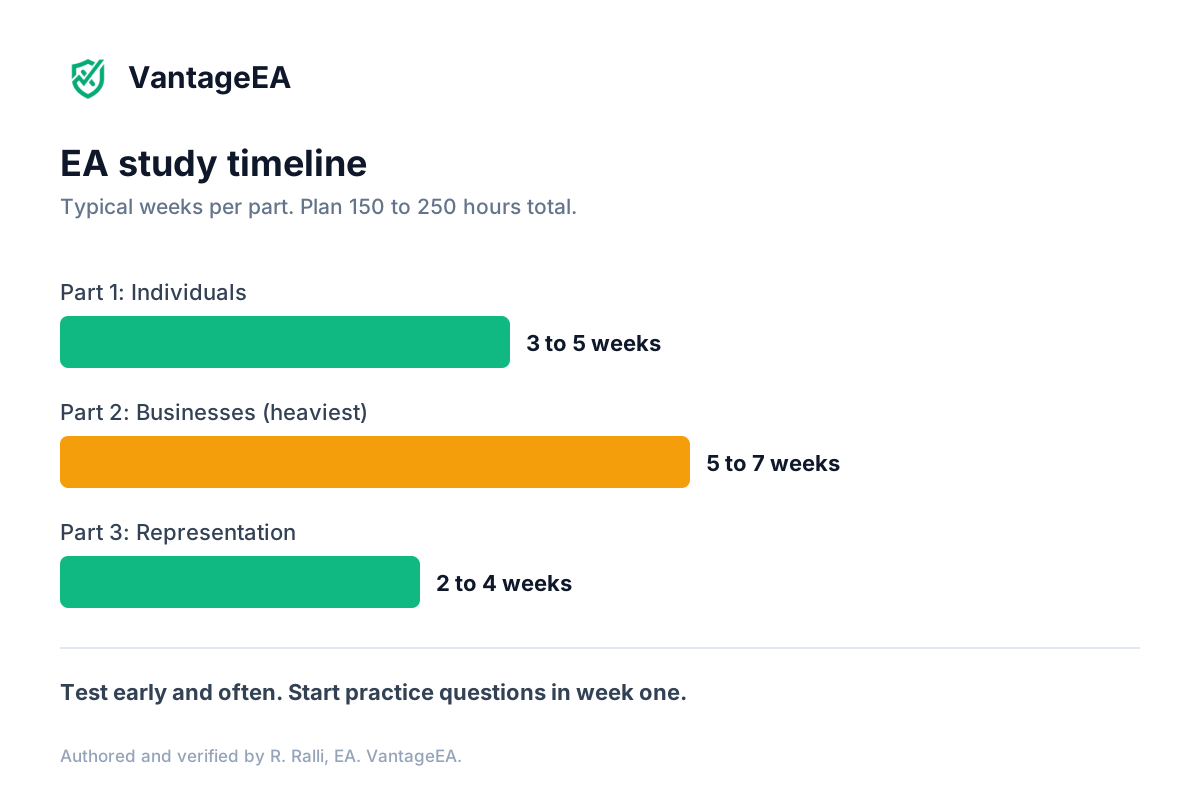
The EA exam takes roughly 190 to 270 hours of study across all three parts, usually spread over 4 to 8 months. Your own timeline depends on your tax background, how many hours you can put in each week, and which exam part you are working on.
Here are study-time guidelines from EA candidates who passed in 2026:
| Exam Part | Recommended Study Hours | Recommended Weeks (10-15 hrs/week) |
|---|---|---|
| Part 1: Individuals | 60-80 hours | 6-8 weeks |
| Part 2: Businesses | 80-120 hours | 8-12 weeks |
| Part 3: Representation | 50-70 hours | 5-7 weeks |
If you work full-time, plan for 10 to 15 hours of study per week. If you can study full-time, you can compress the timeline to 3 to 4 months total. For more on study requirements, see our frequently asked questions page.
These estimates assume you are using a structured program like VantageEA, with practice questions and focused review. Candidates who rely only on IRS publications usually need 20 to 30% more time, since that material isn't organized for exam prep. Working through practice questions does more for your score than reading alone.
What is the best week-by-week study schedule for Part 1 (Individuals)?
A typical EA Part 1 schedule runs 8 weeks at about 10 hours per week, for a total of 80 hours. Part 1 covers individual income tax returns, and most candidates take it first.
Weeks 1-2: Filing fundamentals
- Filing requirements and filing status (single, MFJ, MFS, HOH, QSS)
- Personal exemptions and dependents (qualifying child vs. qualifying relative tests)
- Standard deduction amounts and when to itemize
- Taxpayer identification numbers (SSN, ITIN, ATIN)
- Practice: 50-75 questions on filing fundamentals
- Key IRS reference: Publication 17, Chapters 1-3
Weeks 3-4: Income types
- Wages, salaries, and tips (Form W-2)
- Interest and dividend income (Schedule B)
- Capital gains and losses (Schedule D, Form 8949)
- Rental income and expenses (Schedule E)
- Retirement income (pensions, IRAs, Social Security taxation)
- Other income: gambling, alimony, cancellation of debt
- Practice: 100-150 questions on income types
Weeks 5-6: Deductions and adjustments
- Above-the-line deductions (educator expenses, HSA contributions, student loan interest, self-employment tax deduction)
- Itemized deductions (medical expenses, state and local taxes, mortgage interest, charitable contributions)
- IRA contributions (traditional vs. Roth, deductibility rules)
- Self-employment income and deductions (Schedule C basics)
- Practice: 100-150 questions on deductions
- Key IRS references: Publication 17 (Chapter 10-24), Publication 502, Publication 526
Week 7: Credits and special topics
- Earned Income Tax Credit (EITC): income limits and qualifying rules
- Child Tax Credit and Additional Child Tax Credit
- Education credits (American Opportunity, Lifetime Learning)
- Child and Dependent Care Credit
- Alternative Minimum Tax (AMT) basics
- Estimated tax payments and underpayment penalties
- Practice: 75-100 questions on credits and special topics
Week 8: Review and practice exams
- Take 2-3 full-length timed practice exams (100 questions, 3.5 hours each)
- Review all incorrect answers and identify weak areas
- Focus final study sessions on the weakest 2-3 topic areas
- Review key formulas, thresholds, and phase-out amounts
- Target score: aim for 80%+ on practice exams before sitting for the real test
What is the best week-by-week study schedule for Part 2 (Businesses)?
Part 2 needs the longest schedule: 10 weeks at 10-12 hours per week, for a total of 100 to 120 hours. It's the most content-heavy part (its pass rate was 71% in 2024-2025), so a structured plan helps.
Weeks 1-2: Business entities overview
- Entity types: sole proprietorship, partnership, C corp, S corp, LLC
- Entity selection and tax implications
- Formation, contribution of assets, and basis rules
- Employer Identification Numbers (EINs)
- Practice: 50-75 questions
Weeks 3-4: Sole proprietorships and partnerships
- Schedule C: income, expenses, home office deduction, vehicle expenses
- Self-employment tax calculation (Schedule SE)
- Partnership formation, basis, and allocations
- Form 1065 and Schedule K-1
- Partner's distributive share and guaranteed payments
- Practice: 100-125 questions
Weeks 5-6: Corporations
- C corporation taxation (Form 1120): income, deductions, credits
- Corporate tax rates and accumulated earnings tax
- S corporation requirements and Form 1120-S
- S corp shareholder basis, distributions, and built-in gains
- Corporate formation (Section 351) and liquidation
- Practice: 100-125 questions
Weeks 7-8: Depreciation, assets, and specialized topics
- MACRS depreciation (3, 5, 7, 15, 27.5, 39-year property)
- Section 179 expensing and bonus depreciation
- Listed property rules
- Sale of business assets (Section 1231, 1245, and 1250 recapture)
- Retirement plans: SEP, SIMPLE, 401(k), defined benefit
- Tax-exempt organizations (Section 501(c)(3))
- Farm taxation basics
- Practice: 100-125 questions
- Key IRS references: Publication 946, Publication 334, Publication 542
Weeks 9-10: Review and practice exams
- Take 3-4 full-length timed practice exams
- Review entity comparison charts (partnership vs. S corp vs. C corp)
- Drill depreciation calculations until they are automatic
- Focus on the weakest 3-4 topic areas
- Target score: aim for 80%+ on practice exams before scheduling your PSI appointment
What is the best week-by-week study schedule for Part 3 (Representation)?
Part 3 takes 6 weeks at 10 hours per week, for a total of 60 hours. It needs the least time, but the material on IRS procedures and ethics is unusual and rewards careful reading.
Weeks 1-2: IRS practices and procedures
- IRS organizational structure
- Taxpayer rights (Taxpayer Bill of Rights)
- Filing requirements and amended returns
- Statute of limitations (assessment and collection)
- IRS notices and correspondence
- Practice: 50-75 questions
Weeks 3-4: Representation and ethics
- Circular 230: Duties and restrictions of practice before the IRS
- Power of Attorney (Form 2848) and Tax Information Authorization (Form 8821)
- Due diligence requirements
- Sanctions and disciplinary proceedings
- Privileged communications and confidentiality
- Best practices for tax advisors
- Practice: 75-100 questions
- Key reference: Treasury Department Circular 230 (read this document thoroughly)
Week 5: Collection and examination
- IRS examination process (audit types: correspondence, office, field)
- Appeals process and Alternative Dispute Resolution
- Collection procedures: liens, levies, installment agreements, offers in compromise
- Penalty provisions and abatement
- Innocent spouse relief
- Practice: 75-100 questions
Week 6: Review and practice exams
- Take 2-3 full-length timed practice exams
- Review Circular 230 key provisions
- Memorize important forms and their purposes
- Focus on tricky ethics scenarios
- Target score: aim for 80%+ on practice exams
How should you structure your daily study sessions?
Consistency matters more than long, occasional sessions. Here's a framework for a 2-hour study block:
- Review (15 minutes): go over notes or flashcards from your last session to reinforce what you learned, including the 2025 EA exam numbers to memorize for your part.
- New material (45 minutes): read and study the current topic. Take notes on key concepts, formulas, and thresholds using the Cornell note-taking method.
- Practice questions (45 minutes): answer 25-35 questions on what you just studied, and read the explanations for the ones you miss as well as the ones you get right.
- Summary (15 minutes): write a short summary, and note anything confusing to revisit next time.
For weekend sessions (3-4 hours), use the same structure but stretch each segment, and add a mixed-topic practice set at the end to mimic exam conditions. That also builds test-taking stamina.
What are common mistakes to avoid when studying for the EA exam?
A few common mistakes can cost you hours and lower your score. Watch for these:
- Starting without a plan. Studying without a schedule leaves gaps in your coverage. Use this guide or build your own calendar with specific weekly goals.
- Passive reading. Reading IRS publications alone won't get you there. The exam tests whether you can apply the rules, so practice questions matter.
- Ignoring weak areas. It's tempting to keep studying what you already know, but your biggest gains come from the topics you find hard. Use topic-level analytics to find them.
- Skipping practice exams. Timed exams build stamina and time-management skills. Take at least 2-3 full-length practice exams per part under timed conditions.
- Cramming. The exam covers a broad range of tax law. Steady daily study over weeks beats a last-minute push before your test date.
- Not tracking progress. Use VantageEA's performance analytics to track scores by topic and watch them improve.
- Studying outdated material. Tax law changes every year. Make sure your materials reflect the current tax year (2026 for this cycle).
How should you adjust your study schedule if you are working full-time?
Most candidates study while working full-time, so time management is key. A few strategies that work:
- Morning study. Put in an hour before work, when you're fresh and distractions are low. This is often the best time to absorb complex tax concepts.
- Lunch breaks. Spend 20-30 minutes on flashcards or a quick set of 10-15 questions on your phone through VantageEA's mobile interface.
- Weekend blocks. Set aside 3-4 hours on Saturday or Sunday for longer sessions and full-length practice exams. Treat them as fixed appointments.
- Commute time. If you take public transit, review audio content or digital flashcards on the way.
- Plan around tax season. If you work in tax, avoid scheduling exams from January through April. The annual testing blackout (March to April) lines up with busy season anyway, and the window is generally May 1 to end of February, so plan your sittings for those months.
- Use micro-sessions. Even 10-15 minutes adds up. Keep your materials handy for unexpected free time.
When should you schedule your EA exam date?
Schedule your exam date before you start studying. A fixed date keeps you accountable and stops the plan from slipping indefinitely. Book your PSI appointment 6-12 weeks out, depending on the part, and build your schedule backward from that date.
A firm deadline creates useful pressure and keeps you from preparing forever without ever testing. If your exam date arrives and you don't feel ready, you can reschedule through PSI. Check PSI's current rescheduling deadline and any fee when you book, so you know your options before you need them.
That said, most candidates who follow a structured plan and score 75-80%+ on practice exams are ready to sit. Test anxiety tends to make you feel less prepared than you actually are. For more on judging readiness, see our complete EA exam guide.
How does the EA exam compare to CPA study requirements?
Candidates often ask how EA prep compares to the CPA exam. The EA exam runs about 190 to 270 total study hours across three parts; the CPA exam runs 300 to 400 hours across four sections. The EA exam focuses on federal taxation, while the CPA exam covers a wider range of accounting topics.
For a fuller comparison of study time, pass rates, and career outcomes, read our guide on EA vs CPA certification.
Start your EA exam study schedule today
Build your study plan with VantageEA
VantageEA gives you topic-by-topic practice, performance tracking, and timed practice exams for all three parts of the SEE. It adapts to your progress and shows you which topics need the most work.
Sign up for free and start your first study session. Browse the full topic library for Parts 1, 2, and 3, or check pricing plans for unlimited access to all practice questions and features.