Is the EA exam hard?
No, not for most people who prepare properly. Pass rates ran from 58% to 71% in the 2024-2025 testing year depending on the part, which puts the exam above the CPA and above most licensing tests you'll compare it against. The Enrolled Agent credential has three parts, no degree requirement, and no work-experience gate. If you already know tax, or you're willing to put in 150 to 250 hours of study, you can pass all three.
That said, "hard" depends on where you start. A tax preparer who files business returns every spring may still slip on Part 1's precise individual rules, and find Part 3 manageable. Someone brand new to tax feels every hour of study. The honest version: this exam tests learned skills, namely recall and application of federal tax rules. It rewards steady prep over cramming, and it punishes people who read a review book once and walk in cold.
What are the EA exam pass rates by part?
Here's the breakdown for the three parts of the Special Enrollment Examination (SEE). These are 2024-2025 figures, compiled from Prometric score data (the IRS does not publish official pass rates). The data predates PSI, which delivers the exam from 2026 onward.
| Part | Focus | Pass rate |
|---|---|---|
| Part 1 | Individuals | 58% (the hardest) |
| Part 2 | Businesses | 71% |
| Part 3 | Representation, Practices & Procedures | 70% |
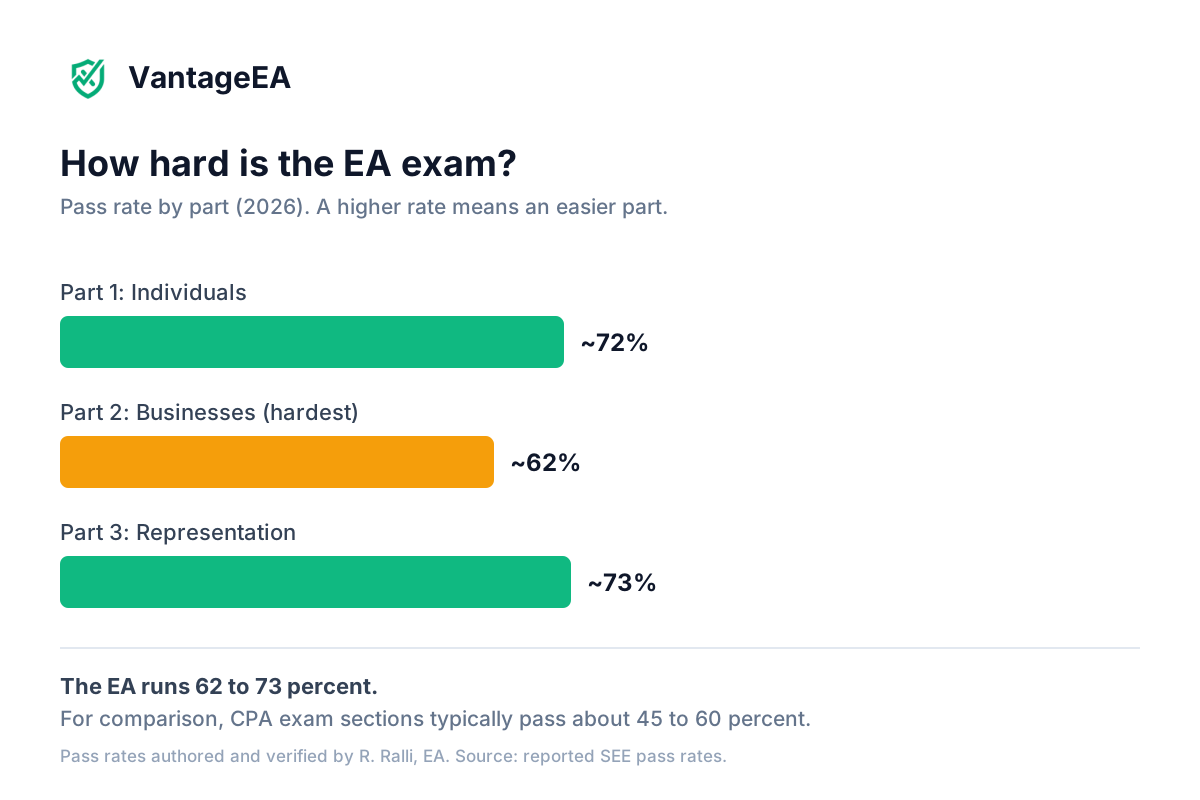
Part 1 has been the low point in each of the last five testing years, while Parts 2 and 3 sit around 70%. That 58% floor still means more than half of candidates pass on a given attempt, so even the toughest part isn't a wall. For the fuller history and how these numbers move over time, see our EA exam pass rates breakdown.
Why is Part 1 (Individuals) the hardest?
Part 1 has the lowest pass rate, at 58% in 2024-2025. It looks familiar to anyone who prepares 1040s, which is the trap: the questions reward exact rules on filing status, dependents, gift and inherited property basis, credits and phase-outs, and a small slip costs points. Candidates who skim it because it feels like their day job are the ones who fall short.
Why does Part 2 (Businesses) take the most study?
Part 2 covers business entities, and there's simply more to memorize than the other two parts. You're dealing with partnerships, S corporations, C corporations, trusts, and estates, plus the rules that differ for each. Its 71% pass rate shows the volume is manageable with enough reps. Nobody is trying to fool you; there's just a lot of ground.
- Partnership and S-corp basis rules, which trip up candidates who only know individual returns
- Depreciation and Section 179 limits, with dollar thresholds that change by tax year
- Entity formation, contributions, and liquidation, each with its own tax treatment
- Farm income, retirement plans for businesses, and employment taxes
If your day job is 1040s, budget more time for Part 2 than you think you need. Candidates who struggle here usually pass on the retake once they've drilled entity basis and depreciation recapture. That's not a sign the material is impossible. It's a sign it needs more reps than the individual side.
Is the EA exam harder than the CPA exam?
No. The EA is easier by every practical measure. The CPA has four sections, requires 150 college credit hours, and demands work experience under a licensed CPA before you get the license. The EA has three parts, no education requirement, and no experience gate at all. CPA section pass rates typically sit around 45% to 60%; the EA ran 58% to 71% in 2024-2025.
The trade-off is scope. The CPA covers audit, financial accounting, and regulation across a wide field. The EA goes deep on federal tax and stops there, which is exactly what you want if tax is your focus and you'd rather not spend two extra years qualifying. We lay out the full side-by-side in EA vs CPA certification.
How much study time do you need?
Plan for 150 to 250 hours total across all three parts. Split that out and it's roughly 40 to 70 hours per part, with Part 2 taking the bigger share. You need a scaled score of 500 on a 200 to 800 scale to pass each part. The IRS doesn't publish a percentage equivalent, so give yourself a margin: aim to score in the mid-80s percent or higher on practice questions before you sit. Passing practice sets is the single clearest signal you're ready.
A workable schedule looks like this:
- Part 1 (Individuals): 3 to 5 weeks at about 10 hours a week
- Part 2 (Businesses): 5 to 7 weeks, the heaviest block by far
- Part 3 (Representation): 2 to 4 weeks, the lightest of the three
Order matters more than people expect. Most candidates start with Part 1 because it builds the foundation the other parts lean on. If you're not sure which one to sit first, we walk through the options in which EA exam part to take first.
What does the EA exam look like in 2026?
Each part is 100 multiple-choice questions in 3.5 hours. No essays, no simulations, just MCQs. Starting in 2026, PSI delivers the exam after it moved from Prometric, and the fee is $317 per part. The testing window runs July 1, 2026 to February 28, 2027, and you get four attempts per part inside that window.
Once you pass a part, it carries over for three years while you finish the rest. So you don't have to clear all three in one sitting, or even one window. That flexibility is a big reason the EA feels lighter than exams that lock you into a fixed calendar and short expiry.
A few specifics worth knowing before you sit:
- Questions lean toward applying rules to facts, so learn the reasoning behind each rule
- You lose nothing for guessing, so answer every single question
- Some items are experimental and unscored, but you can't tell which, so treat all 100 the same
So how do you make it easier?
Test yourself early and test often. Reading a review book front to back feels productive, but you retain far more by answering questions, missing some, and reviewing why you missed them. Start doing practice questions in week one. The people who struggle are usually the ones who saved testing for the end and found out too late where the gaps were.
Track your score by topic as well as overall. If your basis questions sit at 60% while everything else is at 85%, you know exactly where the next three hours go. That's how candidates turn a likely fail into a pass without adding hours, just by aiming the hours they already have.
Want to see where you stand right now? Take our free EA practice test and get a quick read on your weak spots before you pay $317 to sit a part. Do that today, score yourself by topic, then build your study plan around whatever you miss.