The EA exam pass rate was about 66% in the 2024-2025 testing year: 58% for Part 1 (Individuals), 71% for Part 2 (Businesses) and 70% for Part 3 (Representation). Part 1 has had the lowest pass rate of the three parts in every testing year since 2020-2021. The figures are compiled from Prometric score data (the IRS does not publish official pass rates). The data predates PSI, which delivers the exam from 2026 onward.
This comprehensive guide covers each part's pass rate and five-year range, the trend by year, the Part 1 topics that VantageEA mock takers miss most, and what the move to PSI changes. For every key exam number in one place, see the EA exam statistics page.
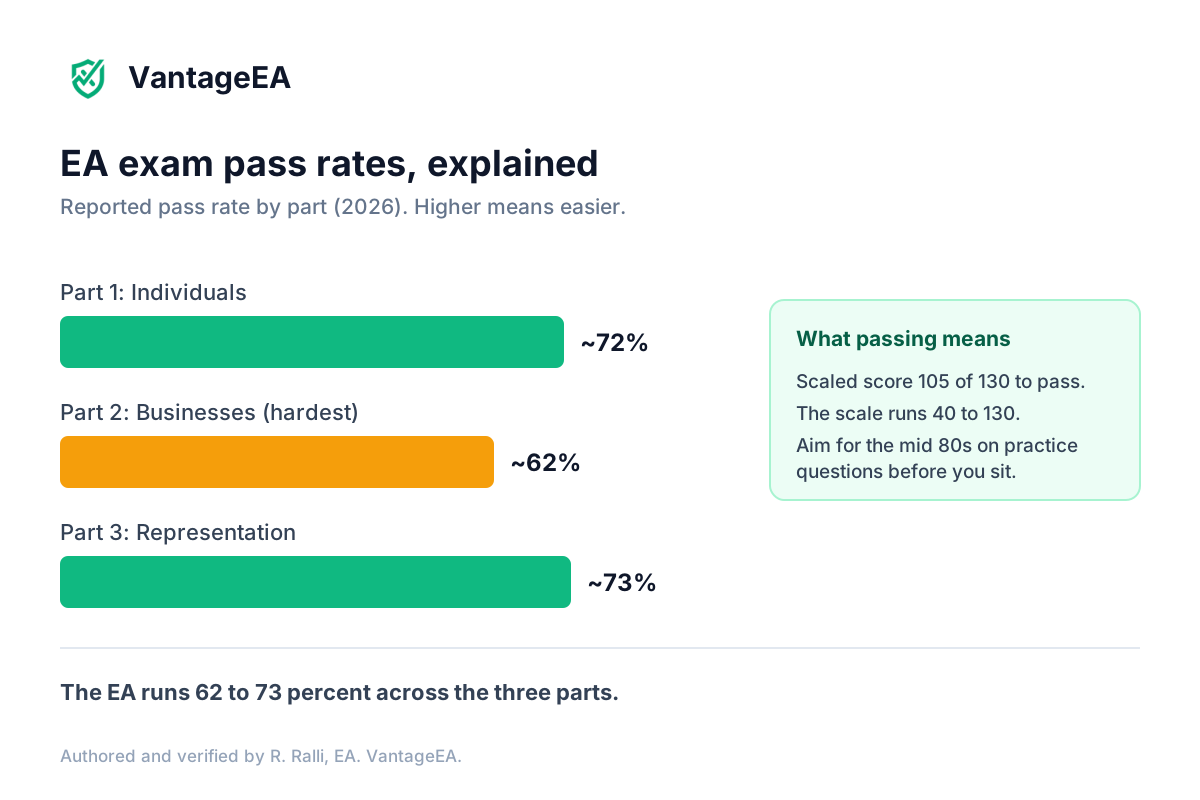
What are the EA exam pass rates by part?
In 2024-2025, 58% of candidates passed Part 1, 71% passed Part 2 and 70% passed Part 3. Here is each part's latest pass rate next to its range over the last five testing years:
| Exam part | 2024-2025 pass rate | Range, 2020-2021 to 2024-2025 |
|---|---|---|
| Part 1: Individuals | 58% | 55% to 66% |
| Part 2: Businesses | 71% | 62% to 72% |
| Part 3: Representation | 70% | 69% to 82% |
Part 1 pass rate: Individuals
Part 1 had a 58% pass rate in 2024-2025 and has ranged from 55% to 66% over the last five testing years, the lowest of the three parts each year. It tests the individual return from start to finish, from filing requirements and dependents to specialized returns such as estate and gift tax. Try 15 free Part 1 practice questions to see the question style.
Part 2 pass rate: Businesses
Part 2 had a 71% pass rate in 2024-2025, with a range of 62% to 72%. It covers the most material of the three parts: sole proprietorships, partnerships, C and S corporations, business deductions and credits, property transactions, and specialized returns such as trusts, estates and exempt organizations. Try 15 free Part 2 practice questions.
Part 3 pass rate: Representation
Part 3 (Representation, Practices and Procedures) had a 70% pass rate in 2024-2025, with a range of 69% to 82%. It covers Circular 230, practice before the IRS, examinations, collections, appeals and preparer penalties. Its questions turn on precise procedural rules, deadlines and the limits of each representative's authority. Try 15 free Part 3 practice questions.
Why is Part 1 the hardest part of the EA exam?
Part 1 is the hardest by pass rate because its questions reward exact rules on topics many candidates think they already know. People who prepare Form 1040 returns at work often underestimate it. Here is where Part 1 points tend to go:
- Thresholds and phaseouts. Credits, deductions and filing requirements change with income, age and filing status, and a question usually tests the exception.
- Basis and property. Inherited, gifted and purchased property each follow different basis rules, and capital gain questions build on them.
- Specialized returns. Estate and gift tax, foreign income and passive activity rules appear less often in day-to-day practice.
- Multi-step calculations. Many questions combine two or three rules, so one slip early in the calculation changes the answer.
Part 2 needs the most study hours because of its volume, yet more candidates pass it. The EA exam format and question types guide shows how these multi-step questions are built.
How have EA exam pass rates changed over time?
All three parts had their highest pass rate in 2020-2021 and lower rates in the years since. Here is how each part moved over the last five testing years, all under Prometric:
| Testing year | Part 1 | Part 2 | Part 3 |
|---|---|---|---|
| 2024-2025 | 58% | 71% | 70% |
| 2023-2024 | 56% | 68% | 70% |
| 2022-2023 | 60% | 68% | 69% |
| 2021-2022 | 55% | 62% | 73% |
| 2020-2021 | 66% | 72% | 82% |
Source: compiled from Prometric score data (the IRS does not publish official pass rates). The data predates PSI, which delivers the exam from 2026 onward.
Part 1 has had the lowest pass rate in every year shown. The IRS refreshes the exam each testing cycle to match current tax law and equates exam versions, so a harder version needs fewer correct answers to pass. That keeps pass rates fairly steady from year to year and makes preparation matter more than the version you receive.
What Part 1 topics do candidates miss most?
The IRS does not publish results by topic, so VantageEA looked at its own Part 1 mock data. Across 3,976 Part 1 questions answered in 96 completed VantageEA mock tests by 39 candidates (February to October 2026), this is the share answered correctly in each IRS domain:
| IRS domain | Answered correctly |
|---|---|
| Specialized Returns for Individuals | 66.6% |
| Income and Assets | 69.0% |
| Deductions and Credits | 73.2% |
| Preliminary Work and Taxpayer Data | 78.4% |
| Taxation, and Advising the Individual Taxpayer | 79.4% |
Specialized returns (estate and gift tax, foreign income and passive activities) and income and assets (basis, investment income and retirement distributions) cost mock takers the most points. Taxation and preliminary work were the strongest areas, at close to 80% correct. These are practice results from a small group of candidates, so read them as a guide to where people slip. They do not predict exam scores.
What changes with PSI in 2026?
PSI took over the exam from Prometric, and its first US testing window runs from July 1, 2026 to February 28, 2027. Scores now run from 200 to 800, with 500 needed to pass. Prometric reported scores on a 40 to 130 scale with 105 to pass, and the IRS has not published a conversion between the two scales.
No pass rates from the PSI window have been published yet, so the 2024-2025 figures above remain the latest. This page will be updated when new figures come out. The Prometric to PSI transition guide covers scheduling and test-day changes.
What score do you need to pass the EA exam?
You need a scaled score of 500 on a 200 to 800 scale. Each part has 100 questions: 85 are scored and 15 are unscored pretest questions that look the same, so answer every question as if it counts.
The IRS converts the number of scored questions you answer correctly to the scale, adjusting for the version you receive, and it does not publish how many correct answers reach 500. Treat any percentage target you see quoted as an estimate. If you do not pass, your score report rates each content area, which shows you what to restudy. You can retake each part up to 4 times per testing window at $317 per attempt, and each part you pass stays valid for 3 years from the date you pass it.
Is there a separate first-time pass rate?
The IRS does not publish official pass rates, and no published source separates first attempts from retakes, so the figures above combine both. A retake goes better when you change how you study:
- Use the score report to target the content areas rated weakest.
- Take full-length timed practice tests to build pacing for 100 questions in 3.5 hours.
- Read the explanation for every question you miss, including the ones you guessed right.
- Book the next attempt once your practice scores are steady, since each attempt costs the full fee.
How should pass rates shape your study plan?
Pass rates show where candidates struggle, and the IRS outline shows where the points are. According to the IRS SEE Part 1 specifications, the 85 scored Part 1 questions split across six domains, all relating to tax year 2025:
| Part 1 domain | Scored questions |
|---|---|
| Preliminary Work and Taxpayer Data | 14 |
| Income and Assets | 17 |
| Deductions and Credits | 17 |
| Taxation | 15 |
| Advising the Individual Taxpayer | 11 |
| Specialized Returns for Individuals | 11 |
Give the most time to the largest domains and to the areas mock takers miss most. These study ranges work for most candidates:
- Part 1 (Individuals): 60 to 80 hours, with extra time on specialized returns and income and assets.
- Part 2 (Businesses): 80 to 120 hours, the most material of the three parts.
- Part 3 (Representation): 50 to 70 hours, with careful reading of Circular 230.
There is no required order for the three parts. The guide to which EA exam part to take first compares the common orders, and the EA exam study schedule turns them into a week-by-week plan.
How can you practice for each part?
Practice with VantageEA
Our free practice questions cover each part, with answers, explanations and IRS sources: Part 1, Part 2 and Part 3.
For a full exam run, create a free account. It includes a 50-question mock timed like the PSI exam, with a scored result that shows your weakest topics.