The first section of the Special Enrollment Examination you sit for is simply a scheduling decision. You still have to pass all three parts, and the order never changes that. What it does change is your momentum. Where you start affects how confidently you begin and how much room you leave yourself inside the three-year window. This guide explains how the three parts differ, what the pass rates actually tell you, and how to pick a starting point that fits your background.
What are the three parts of the EA exam?
The EA exam is formally the Special Enrollment Examination, or SEE. It has three parts, and each one covers a different area of federal tax practice. You can take them in any order and on separate days, which is the whole reason the sequencing question comes up.
The format is identical across all three. Every part has 100 multiple-choice questions, runs 3.5 hours, and is scored on a scaled range from 200 to 800. You need 500 to pass. The 40 to 130 scale (105 to pass) was used under Prometric before July 2026, so treat any source that still quotes it as out of date.
Part 1: Individuals
Covers individual taxation: income, deductions, credits, filing status, and basis. This is the foundation the later parts assume you already understand. It is historically the section candidates find most demanding.
Part 2: Businesses
Covers business entities, partnerships, corporations, trusts, retirement plans, and business income and expenses. It carries the most content of the three.
Part 3: Representation, practices, and procedures
Covers practitioner ethics, representation before the IRS, filing procedures, and rules of practice. It usually takes the least study time.
For the full subject breakdown within each section, read the EA exam topics outline before you lock in a schedule.
Which EA exam part should you take first?
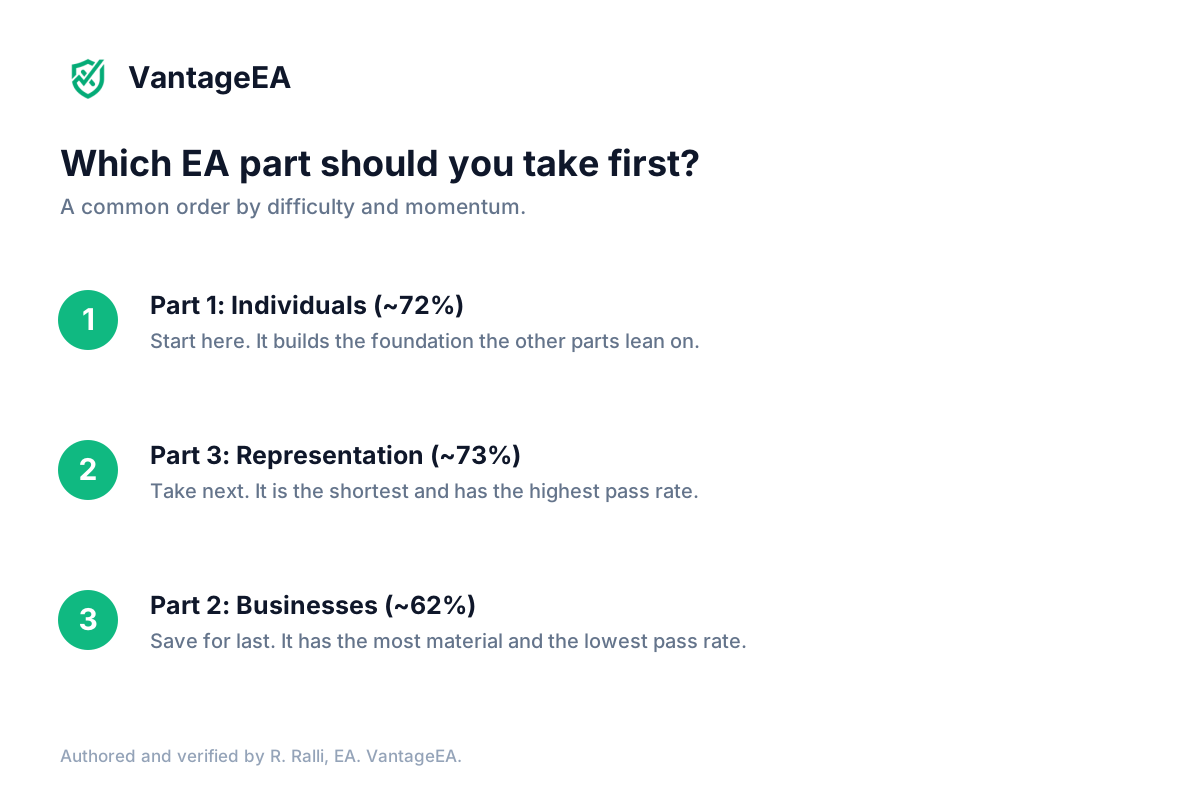
For most candidates the usual starting point is Part 1, then Part 2, then Part 3. The reasoning is simple. Concepts you meet in Part 1, such as income recognition, basis, and deductions, reappear in more advanced forms in Part 2. Learn them once in an individual context and you spend less time relearning them for businesses.
Treat this as guidance. Your professional background may point you somewhere else, and that is a valid reason to change the order.
- Part 1, Individuals: establish the core tax principles.
- Part 2, Businesses: apply and extend those principles to entities.
- Part 3, Representation: finish with the procedural and ethics material.
If you want to see how the individual-tax material feels before you decide, preview it on the Part 1 study hub.
Is EA Part 1 or Part 2 harder?
By pass rate, Part 1 is harder. In 2024-2025, Part 1 passed at 58% and Part 2 at 71%. More candidates fall short on Part 1, even though Part 2 covers a larger volume of material.
The reason is worth understanding. Part 1 rewards precision on a defined set of individual-tax rules, and a small mistake on gift or inherited property basis or a credit calculation costs you points. Part 2 covers more ground, but its questions tend to be more procedural, which lifts the pass rate despite the heavier load.
So the two parts are hard in different ways. Part 1 asks for depth and accuracy on a narrower set of rules. Part 2 asks you to absorb a much larger body of business-entity material. Knowing which kind of difficulty suits you is more useful than knowing which number is lower.
For the figures in context, the EA exam pass rates breakdown explains how they have shifted across recent testing windows.
What is the hardest EA exam part?
By pass rate, Part 1 is historically the hardest. Its 58% pass rate in 2024-2025 trailed Part 2 at 71% and Part 3 at 70%.
Pass rate is not the whole story, though. Part 2 demands the most study time for many people because of its sheer content volume, so the part that feels hardest depends on what you already know. Someone who prepares individual returns every day may find Part 1 manageable. Someone new to entity taxation may struggle more with Part 2.
Put plainly: Part 1 is the hardest by pass rate, Part 2 is the heaviest by content, and Part 3 is the lightest by study hours. Those are three separate measures, and they do not all point at the same section.
To judge the entity material against what you already know, look at the Part 2 study hub.
How do the three parts compare on pass rate and study hours?
Here are the three sections next to each other, using 2024-2025 pass rates (compiled from Prometric score data (the IRS does not publish official pass rates)) and common candidate study estimates.
| Part | Approximate pass rate | Approximate study hours | Relative difficulty |
|---|---|---|---|
| Part 1: Individuals | 58% | About 80 to 100 hours | Historically the hardest |
| Part 2: Businesses | 71% | About 80 to 100 hours | Most content-heavy |
| Part 3: Representation | 70% | About 60 to 80 hours | Shortest to prepare |
That spread is why the order is a genuine choice and not a formality. If you want a timeline that maps these hours across weeks, the EA exam study schedule shows how to distribute preparation across all three parts.
Why does the order you choose matter?
Your total requirement is fixed. You must pass all three parts no matter the sequence. What the order changes is your momentum and how you set yourself up, both mentally and logistically.
Start with the section closest to your daily work, and an early pass can confirm that your study methods work while giving you some confidence. Start with the hardest part, and you clear the toughest hurdle while your motivation is still fresh. Both approaches are reasonable. Pick the one that matches how you actually study.
- Begin with the part closest to your experience for an early win.
- Begin with Part 1 so the historically toughest section is behind you early.
- Begin with Part 1 to lock in the concepts that Part 2 reuses.
For a fuller picture of the credential and its milestones, see the enrolled agent exam overview.
When should you start with Part 2 or Part 3 instead?
Reordering makes sense when your work is concentrated in business taxation or representation rather than individual returns. The standard sequence assumes you are starting from individual tax, and that assumption does not hold for everyone.
If you mostly handle business clients, entity returns and partnership rules may already feel familiar, which can make Part 2 a confident first step. If your role centers on representation, collections, or appeals, Part 3 might be where you hold the most existing knowledge. The honest question is where your day-to-day expertise sits.
- Business-heavy background: starting with Part 2 can build on your entity-tax familiarity.
- Representation background: starting with Part 3 can draw on your procedural and ethics knowledge.
- New or general practitioner: Part 1 first is still the safer foundation.
You can gauge your representation readiness on the Part 3 study hub before deciding whether it belongs at the front of your plan. A quick self-check is whether you can explain the rules in this Form 2848 vs Form 8821 guide without notes.
How does the three-year window affect your order?
Each part you pass carries over for up to 3 years from the date you pass it. Your first passing score starts the clock on your earliest credit, so your opening choice sets the pace for everything that follows.
The window rewards steady progress. Passing an accessible section first starts the three years with a win already behind you. Starting with the hardest section reduces the risk that Part 1 becomes a late-stage problem when time is running low. Either way, plan the remaining parts so none of them gets squeezed against the deadline.
| Starting choice | Effect on the three-year window |
|---|---|
| Start with Part 1 (hardest) | Clears the toughest section early and leaves the higher-pass-rate parts for later. |
| Start with your strongest area | Produces an early pass and confirms your study approach before deadline pressure grows. |
| Delay your weakest area | Risks pushing a difficult part toward the deadline, so schedule it on purpose. |
Since the order affects momentum and not obligation, the practical goal is simple: keep all three parts moving so you never hit a bottleneck.
Can you retake a part if you do not pass?
Yes. You can attempt each part up to four times per testing window, which gives you room to recover if a section does not go your way. That allowance is another reason the order is a matter of strategy rather than risk.
As of March 1, 2026, the exam is administered by PSI, and the fee is $317 per part for every attempt. Because a retake means paying that fee again, walking into each section well prepared protects both your timeline and your budget. Timed practice under realistic conditions is the most direct way to know you are ready before you schedule.
- Attempts: up to four per part within a testing window.
- Administrator: PSI, effective March 1, 2026.
- Fee: $317 per part, charged on each attempt.
You can check your readiness at no cost with a free EA practice test before committing a fee to any part.
How can VantageEA help you choose and prepare?
Picking a starting part is easier when you can see how you perform across all three sections before you register. VantageEA is a study platform built around per-part practice questions, performance analytics, and timed practice exams that match the PSI format.
The analytics are what help with sequencing. As you work through questions in Part 1, Part 2, and Part 3, the platform shows where your scores are strongest, which can point you toward a confident first attempt or flag the section that needs the most work.
- Per-part practice questions isolate individual, business, and representation topics as you study.
- Performance analytics compare your readiness across parts to guide your order.
- Timed practice exams rehearse the 3.5-hour, 100-question format before test day.
With that data in front of you, you can return to the EA exam topics knowing where to begin.
Making the call on your first part
Your first part sets the pace for the whole three-year window, so make the choice with data instead of a guess. The common Part 1, Part 2, Part 3 order works for most people. If your background sits in business or representation, reorder around it. Line up your start with your strengths and the rest of the sequence gets easier to plan.
Start preparing with VantageEA
Get per-part practice questions, performance analytics, and timed practice exams so you can see which section to take first and plan the rest.
Create your free account · Browse EA exam topics · View pricing plans