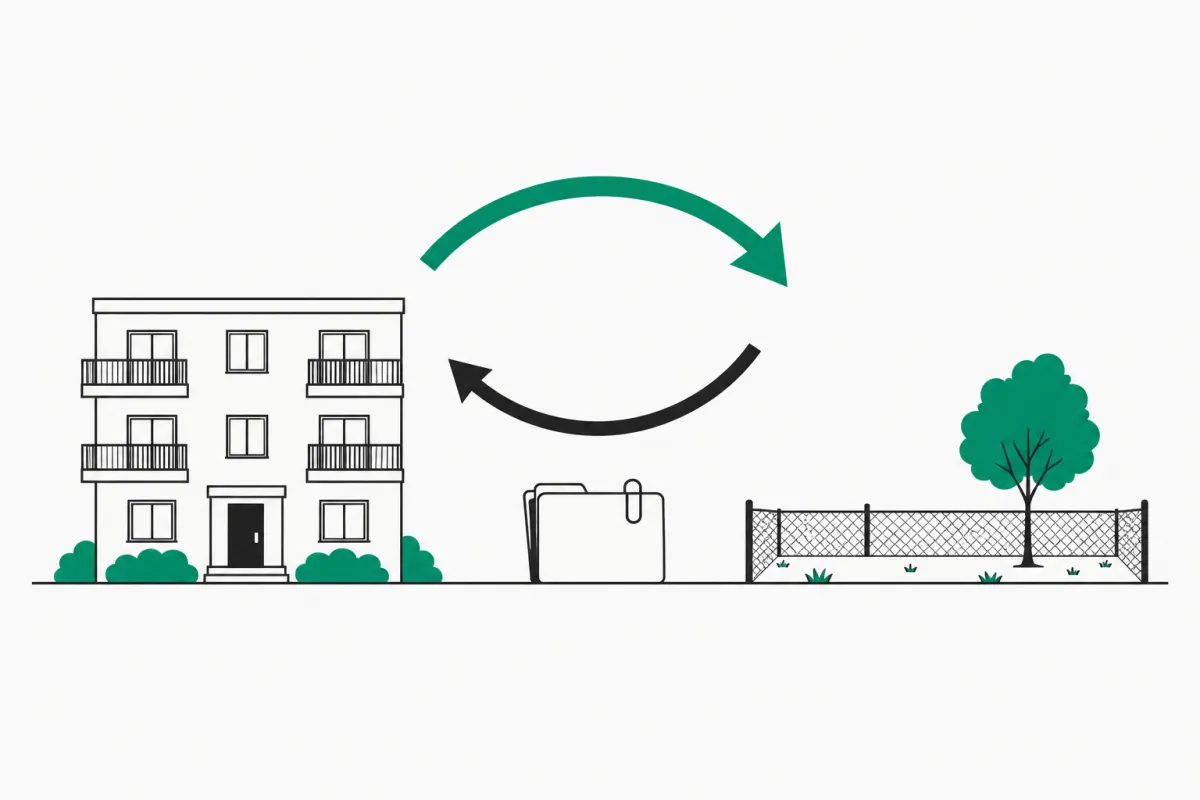
A Section 1031 like-kind exchange lets you trade real property held for business or investment for other like-kind real property and defer the gain. You recognize gain only up to the boot you receive (cash, other property, or net debt relief), a realized loss is never recognized, and since 2018 only real property qualifies.
Part 2 of the Special Enrollment Examination (SEE) gives you a basis, a fair market value, some cash, and a mortgage or two, then asks for the taxable gain or the new basis. This guide from VantageEA, an Enrolled Agent (EA) exam practice platform, covers the calculations, deadlines, related party rules, and common traps.
What property qualifies for a Section 1031 like-kind exchange?
Only real property held for productive use in a trade or business or for investment qualifies, on both sides of the trade. Like-kind describes the nature of the property, so US real estate is like-kind to other US real estate whatever its grade or quality:
| Exchange | Qualifies? | Reason |
|---|---|---|
| Business warehouse for vacant investment land | Yes | Improved and unimproved real estate are like-kind |
| Owned building for a lease of 30 years or more | Yes | A lease that long counts as real estate |
| Business truck for newer equipment | No | Personal property no longer qualifies |
| Lots a developer holds for sale | No | Property held for sale is excluded |
| US building for a building abroad | No | US and foreign real property are not like-kind |
| Your main home or shares of stock | No | Personal-use and intangible property are excluded |
The IRS notice that like-kind exchanges are now limited to real property explains the change for exchanges after 2017, and IRS Publication 544, Sales and Other Dispositions of Assets, lists what qualifies. The like-kind exchanges topic page drills each category. If the property is not real estate, Section 1031 does not apply.
How do you figure realized gain and recognized gain?
Realized gain is the amount realized minus the adjusted basis of the property you give up. Recognized gain, the part taxed now, is the smaller of the realized gain or the boot received, and the rest is deferred. An investor trades land with an adjusted basis of $180,000 for a warehouse worth $260,000 plus $30,000 in cash:
| Step | Amount |
|---|---|
| Amount realized (warehouse plus cash) | $290,000 |
| Less adjusted basis of the land | $180,000 |
| Realized gain | $110,000 |
| Recognized gain (smaller of $110,000 or $30,000 of boot) | $30,000 |
| Deferred gain | $80,000 |
With a $320,000 basis instead, the same deal produces a $30,000 realized loss. Section 1031 bars that loss even though cash changed hands, so nothing is recognized. Boot can make part of a gain taxable, and it can never make a loss deductible.
What counts as boot in a like-kind exchange?
Boot is anything you receive that is not like-kind real property:
- Cash: including exchange funds an intermediary releases to you.
- Other property: at fair market value, such as equipment, a vehicle, stock, or the buyer's note.
- Net debt relief: your mortgage taken over by the other party, to the extent it exceeds the debt you take on.
Cash you pay, debt you assume, and other property you hand over are boot paid, which adds to your new basis. Appliances and furnishings that come with an apartment building are boot when you figure gain, even though the identification rules ignore them when they are worth no more than 15% of the building. Anything you receive that is not real property counts as boot.
How do mortgages and closing costs change the boot?
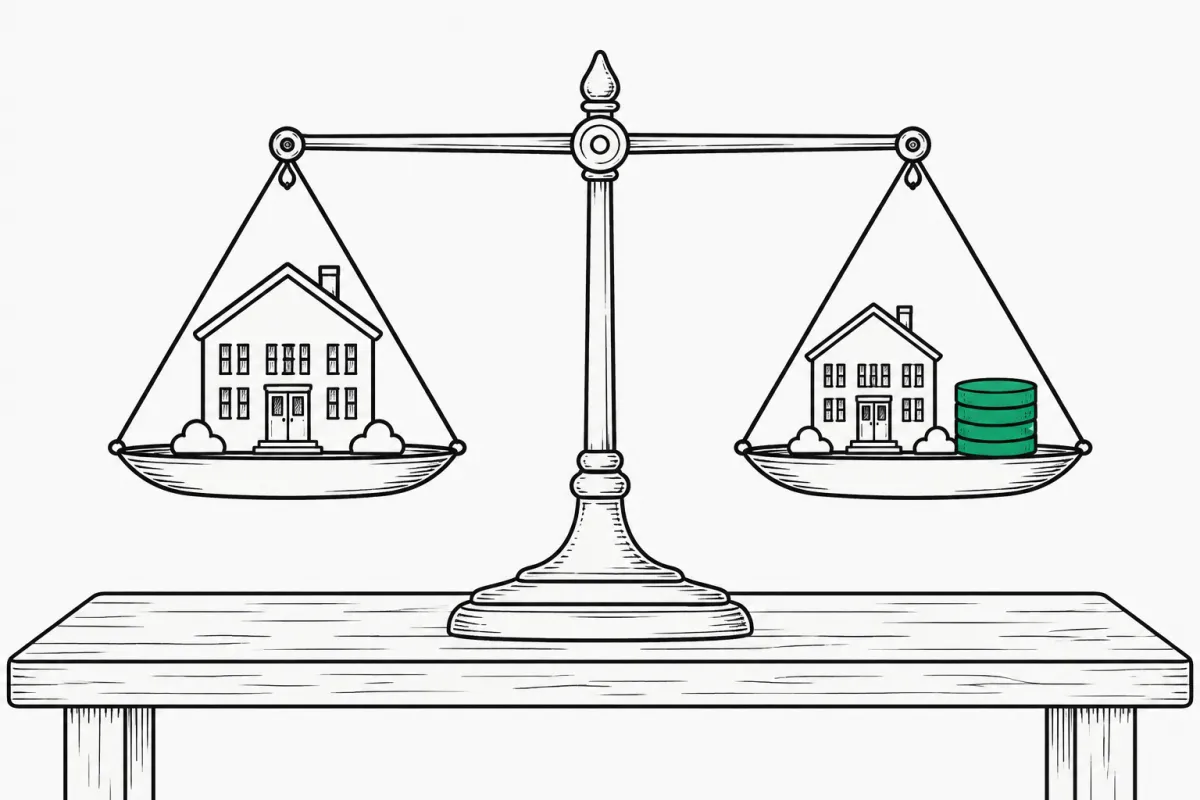
Debt relief counts as cash received, and Publication 544 lets you reduce it by debt you assume, cash you pay, and other property you give up. Debt you assume can never offset cash you receive, and exchange expenses (closing costs) you pay reduce cash boot.
| Scenario | Boot received |
|---|---|
| You shed a $120,000 mortgage and assume a $70,000 one | $50,000 |
| You shed a $60,000 mortgage and assume a $90,000 one | $0 |
| You assume a $40,000 mortgage and receive $25,000 cash | $25,000 |
| You receive $20,000 cash and pay $6,000 of closing costs | $14,000 |
A business owner gives up an office building with an adjusted basis of $350,000, worth $600,000 and subject to a $150,000 mortgage, for a building worth $500,000 subject to a $50,000 mortgage. Each side assumes the other's debt, with no cash:
- Amount realized: $500,000 plus $150,000 of debt relief, less $50,000 of debt assumed, or $600,000.
- Realized gain: $600,000 less $350,000, or $250,000.
- Recognized gain: the $100,000 of net debt relief, with $150,000 deferred.
Debt you take on can cancel debt you shed, and it never cancels cash you receive.
How do you figure the basis of the replacement property?
The replacement property takes a substituted basis: the adjusted basis of the property you gave up, plus boot paid and gain recognized, minus boot received and loss recognized. As a check, the result equals the new property's fair market value minus the deferred gain.
| Example | Calculation | New basis |
|---|---|---|
| Land for a warehouse plus $30,000 cash | $180,000 plus $30,000 gain, less $30,000 cash | $180,000 |
| Office building swap with mortgages | $350,000 plus $50,000 debt assumed and $100,000 gain, less $150,000 debt relief | $350,000 |
| Land with a $320,000 basis (loss case) | $320,000 less $30,000 cash | $290,000 |
Boot property you receive takes its fair market value as basis. The old holding period carries over when the old property was a capital asset or Section 1231 property, and recognized gain can still be recapture under the Section 1231, 1245, and 1250 recapture rules. Like a gift (see the gift vs inherited property basis guide), an exchange carries basis forward, so the deferred gain comes due in a later taxable sale.
What are the 45-day and 180-day deadlines in a deferred exchange?
In a deferred exchange, the replacement arrives after you transfer your property. You must identify the replacement within 45 days and receive it by the earlier of the 180th day or your return due date, including extensions. These are calendar days, and neither deadline moves for a weekend or holiday. For a rental transferred on November 1, 2025:
- Identification deadline: December 16, 2025.
- 180th day: April 30, 2026.
- Return due date: April 15, 2026 for a calendar-year individual, which ends the period early unless the return is extended.
The identification must be signed, written, and delivered to someone in the exchange other than you or a disqualified person. You can identify three properties of any value, or any number worth no more than 200% of the property you gave up. If you exceed both limits, identified property counts only if you receive it within the 45 days or acquire at least 95% of the total value identified.
Qualified intermediaries
If you actually or constructively receive the sale cash before you get the replacement, the deal becomes a taxable sale. A qualified intermediary holds the funds under a written agreement that limits your rights to them. A related person cannot serve, and neither can your agent, meaning anyone who acted as your employee, attorney, accountant, broker, or real estate agent in the prior 2 years. The Instructions for Form 8824, Like-Kind Exchanges, repeat these rules. The accountant who prepared your return last year cannot hold your exchange funds this year.
What happens when you exchange property with a related party?
If you exchange with a related person and either of you disposes of the exchanged property within 2 years after the last transfer, both of you report the deferred gain in the year of that disposition. Related persons include your spouse, children, grandchildren, parents, grandparents, and siblings, plus corporations and partnerships in which you own more than 50%.
A disposition after either person's death, through an involuntary conversion, or with no tax avoidance purpose does not trigger the gain, and you file Form 8824 for the exchange year and the 2 years after it. Suppose an owner trades a duplex with a $140,000 basis, worth $310,000, for a sibling's lot of equal value in March 2025, and the sibling sells the duplex in January 2027. The owner reports the $170,000 deferred gain on the 2027 return. The installment sales and related parties topic covers who counts as related. With family members, the deferral is final only after 2 years pass.
How is a like-kind exchange different from an involuntary conversion?
Both postpone gain by carrying basis into replacement property. Section 1033 covers property that is destroyed, stolen, or condemned, and it reaches personal property and a main home too.
| Feature | Section 1031 exchange | Section 1033 conversion |
|---|---|---|
| Trigger | An exchange you choose | Casualty, theft, or condemnation |
| Replacement | Like-kind real property | Similar or related in service or use (like-kind for condemned business or investment real estate) |
| Time limit | 45 days to identify, 180 days to receive | 2 years after the end of the first tax year with gain; 3 years for condemned business or investment real estate; 4 years for a main home in a federally declared disaster area |
| Gain recognized | Smaller of realized gain or boot | Smaller of realized gain or proceeds not reinvested |
A warehouse with a $320,000 basis burns down in 2025, and insurance pays $500,000, a $180,000 gain. If the owner spends $450,000 on a replacement by December 31, 2027 and elects to postpone, $50,000 is recognized and the new basis is $450,000 less the $130,000 postponed gain, or $320,000. Section 1031 taxes the boot you take out, and Section 1033 taxes the proceeds you keep.
Which like-kind exchange traps cost the most points on Part 2?
Part 2 (Businesses) had a pass rate of 71% in the 2024-2025 testing year, according to figures compiled from Prometric score data (the IRS does not publish official pass rates). These errors come up often:
- Taxing boot on a loss: a realized loss means zero recognized gain.
- Netting debt against cash: debt you assume never offsets cash you receive.
- Moving a deadline: day 45 and day 180 stay fixed, and an unextended return can end the period sooner.
- Excluding gain on a former rental: a home acquired in an exchange must be held 5 years before the home sale exclusion applies.
Try this one. An investor gives up a building with a $210,000 basis, worth $400,000 and subject to a $90,000 mortgage the other party assumes, for a building worth $340,000 with a $60,000 mortgage the investor assumes, plus $30,000 in cash. The realized gain is $190,000. Boot is $30,000 of net debt relief plus $30,000 of cash, so $60,000 is recognized and the new basis is $210,000. Read how hard each EA exam part is and the EA Part 2 business taxation exam overview next.
How should you study like-kind exchanges for the 2026 EA exam?
Each part of the SEE has 100 questions (85 scored and 15 experimental) in 3.5 hours, and you need a scaled score of 500 on the 200 to 800 scale to pass. According to the IRS Enrolled Agents FAQ, the US window runs July 1, 2026 to February 28, 2027 at PSI test centers or through PSI online proctoring, and the fee is $317 per part.
- Learn one order: amount realized, realized gain, boot, recognized gain, then basis.
- List the boot on every problem: cash, other property, and net debt relief, less closing costs.
- Answer timed questions and tag each miss with the step that went wrong.
The guide to EA exam numbers to memorize for 2026 collects other Part 2 figures, and the week-by-week EA exam study schedule places property transactions in its Part 2 block. VantageEA EA mock tests report your number correct out of 100, with 70 correct as the pass mark, plus an estimated PSI score range. Start with a free EA practice test.
Ready to Practice Part 2 Like-Kind Exchange Questions?
Practice Section 1031 exchanges with VantageEA EA mock tests
VantageEA, an Enrolled Agent exam practice platform, gives you 5,000+ practice questions and topic analytics that show whether boot, basis, and exchange deadline questions are costing you points.
Take a free EA practice test · Study the like-kind exchanges topic · View plans and pricing