If you're considering a career in tax or accounting, two credentials come up again and again: the Enrolled Agent (EA) and the Certified Public Accountant (CPA). Both can advance your career, but they differ in scope, requirements, cost, and focus. Here is how the two compare in 2026, and how to decide which one fits your goals.
What is the difference between an EA and a CPA?
The main difference comes down to who issues the credential and what it lets you do. An EA is a federally licensed tax practitioner authorized under IRS Circular 230. A CPA is a state-licensed accounting professional with broader but state-specific authority.
- Enrolled Agent (EA): A federal credential granted by the IRS (Department of the Treasury). EAs specialize in taxation and have unlimited rights to represent taxpayers before the IRS in all 50 states and U.S. territories for audits, collections, and appeals.
- Certified Public Accountant (CPA): A state license granted by individual state boards of accountancy. CPAs cover auditing, financial reporting, consulting, and tax services. The license is state-specific, though many states offer reciprocity agreements.
An EA is a tax specialist with deep expertise in IRS matters and federal tax law. A CPA is a generalist who may handle tax work alongside auditing and financial reporting. Both can represent taxpayers before the IRS, but only CPAs can perform audits and attest to financial statements. EAs are not authorized to provide those services.
What are the education requirements for each?
Education is where the two credentials diverge most, and it is often the deciding factor for career changers and people without an accounting degree.
EA education requirements
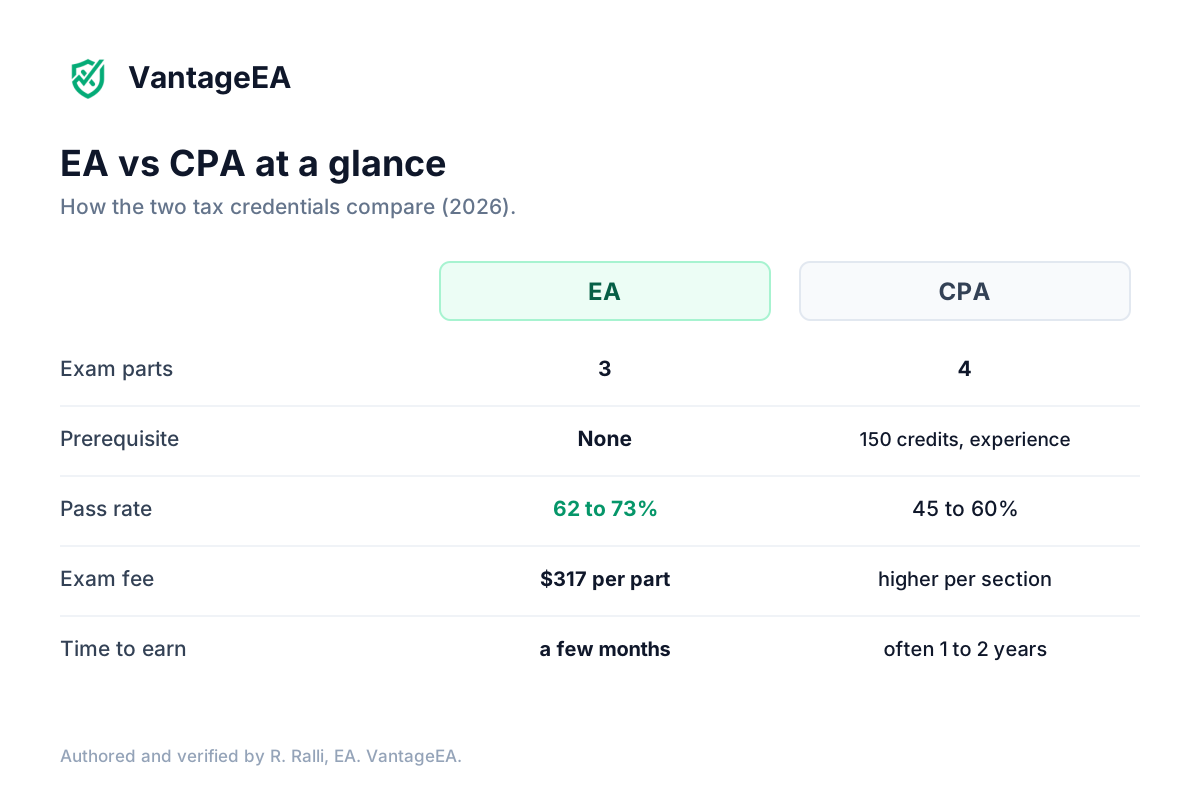
There are no education requirements to become an Enrolled Agent. You don't need a college degree, accounting coursework, or any specific academic background. Anyone with a valid Taxpayer Identification Number (SSN or ITIN) can register for the Special Enrollment Examination. That accessibility is what draws career changers and self-taught tax professionals who want to skip the cost and time of a four-year degree.
CPA education requirements
CPA candidates must meet education requirements that vary by state but generally include:
- A bachelor's degree (120 credit hours minimum to sit for the exam)
- 150 credit hours to become licensed (equivalent to a master's degree in many cases)
- Specific accounting and business coursework (typically 24-30 credits in accounting and 24 credits in business)
- 1-2 years of supervised work experience under a licensed CPA
The 150-hour requirement is a real barrier. Many candidates pursue a master's degree or extra undergraduate coursework beyond a standard four-year degree. That adds $20,000 to $60,000+ in education costs on top of the exam and extends the timeline to licensure by 1-2 years.
How do the EA and CPA exams compare?
The two exams differ in structure, content, and difficulty.
The EA exam (Special Enrollment Examination)
The SEE has three parts. Each has 100 multiple-choice questions (85 scored, 15 pretest) and a 3.5-hour time limit:
- Part 1: Individuals covers individual taxation, filing status, income, deductions, credits, and basis.
- Part 2: Businesses covers business taxation, including entities, payroll, retirement plans, and tax-exempt organizations.
- Part 3: Representation covers IRS practices and procedures, ethics, and Circular 230 requirements.
Each part costs $317 to take (as of the May 2026 cycle), for a total of $951. Each passed part carries over for up to 3 years from the date you pass it. US candidates can test remotely through PSI online proctoring or at a PSI test center, and the window is generally May 1 to end of February, with a spring blackout for content updates. The passing score is 500 on a scaled range of 200 to 800. You can also read up on EA exam pass rates and study strategies.
The CPA exam (Uniform CPA Examination)
The Uniform CPA Examination has four sections. Each runs 4 hours and mixes multiple-choice questions, task-based simulations, and written communication tasks:
- Auditing and Attestation (AUD): audit procedures, attestation engagements, and professional responsibilities
- Business Environment and Concepts (BEC): corporate governance, economic concepts, financial management, and IT
- Financial Accounting and Reporting (FAR): GAAP, financial statements, and governmental accounting
- Regulation (REG): federal taxation, business law, and ethics
Each section costs about $238 in exam fees, plus application and registration fees that vary by state (typically $50-$200). The total exam cost usually runs $1,000 to $1,500+. You must pass all four sections within an 18-month rolling window.
How much does each credential cost in total?
Once you include education expenses, the cost gap between the two paths is large.
| Cost Category | Enrolled Agent | CPA |
|---|---|---|
| Education | $0 (no degree required) | $40,000 to $100,000+ (150 credit hours) |
| Exam Fees | $951 (3 parts × $317) | $1,000 to $1,500+ |
| Study Materials | $200 to $1,000 | $1,500 to $3,500 |
| Application/Licensing | $140 (Form 23) + $19.75 (PTIN) | $100 to $500 (varies by state) |
| Total (excluding education) | $958 to $1,758 | $2,600 to $5,500+ |
| Total (including education) | $958 to $1,758 | $42,600 to $105,500+ |
With education included, the CPA path can cost $40,000 to $100,000+ more than the EA path. For someone who wants to specialize in taxation without a graduate degree, the EA is far cheaper to earn.
What are the career opportunities for each?
Career paths follow the focus of each credential. EAs concentrate on tax, while CPAs have a wider range of accounting work.
EA career paths
- Tax preparation and planning (individual and business)
- IRS audit representation and resolution
- Tax controversy and collections work
- Independent tax practice ownership
- Tax consulting for small businesses and high-net-worth individuals
- State and local tax (SALT) advisory
- International tax compliance and planning
- Tax software development and consulting
CPA career paths
- All EA career paths listed above, plus:
- Financial statement auditing and assurance services
- Corporate accounting and controllership
- Forensic accounting and fraud examination
- Management consulting
- CFO and executive finance roles
- Valuation and business advisory services
- Government and nonprofit accounting
If your main interest is taxation and IRS representation, the EA gives you what you need to build a tax practice. If you want a broader accounting career that includes auditing, financial reporting, or corporate finance leadership, the CPA is the better fit. Many tax-focused professionals find the EA offers all the authority they need without the added cost and time of CPA licensure.
How do EA and CPA salaries compare?
Salaries depend on experience, location, specialization, and the type of practice you work in. Both credentials can reach six figures with the right expertise and client base.
- Enrolled Agents: Entry-level EAs typically earn $45,000 to $60,000. Mid-career EAs average $55,000 to $80,000. Experienced EAs and practice owners can earn $100,000 to $200,000+, especially those who specialize in IRS representation, international tax, or high-net-worth planning. EAs in major metro areas or with niche expertise command premium rates.
- CPAs: Entry-level CPAs typically earn $55,000 to $70,000. Mid-career CPAs average $65,000 to $95,000. Senior CPAs, firm partners, and CFOs can earn $150,000 to $300,000+. Big Four partners can exceed $500,000 in total compensation.
CPAs invest much more up front: 4-6 years of college plus $40,000-$100,000+ in costs, and more time before licensure. Once you weigh the return on investment, the EA often delivers comparable or better value for people focused on tax practice. An EA who starts practicing 3-4 years earlier than a CPA candidate, thanks to no degree requirement, also banks earning years and experience that compound over a career.
Can you hold both EA and CPA certifications?
Yes, and many tax professionals do. Holding both gives you the broad accounting expertise and audit authority of a CPA plus the deep tax specialization and federal IRS representation of an EA. The combination pays off in a few situations:
- Running a full-service accounting practice that offers tax, audit, and advisory services
- Specializing in tax controversy while keeping audit clients
- Working at accounting firms that value both tax expertise and CPA licensure
- Pursuing leadership roles that call for broad credentials
Some professionals earn the EA first, since it has no education prerequisites, then pursue the CPA once they finish the 150 credit hour requirement. That lets them start practicing and earning while they work toward the license. Others earn the CPA first through traditional education and add the EA to show clients their specialized tax expertise.
Which certification should you choose?
The right choice depends on your goals, educational background, budget, and how soon you want to practice. Use the checklist below.
Choose EA if:
- You are drawn to tax law and IRS representation
- You want to start practicing quickly (licensure is possible within 6-12 months)
- You do not have a college degree, or do not want to pursue one
- You want a low-cost path to professional credentials (under $2,000 total)
- You plan to focus on individual or business tax preparation and planning
- You want to run your own independent tax practice
- You are a career changer entering the tax profession
Choose CPA if:
- You want a broad accounting career beyond taxation
- You are interested in auditing, attestation, or financial reporting
- You already have or plan to complete 150 credit hours of education
- You want to work at a Big Four accounting firm or large regional firm
- You aim for CFO or executive finance roles
- You want state-specific licensure and reciprocity flexibility
- You have the budget and timeline for a 5-6 year education and licensure path
Choose both if:
- You want maximum credibility and flexibility across tax and accounting
- You plan to offer tax, audit, and advisory services together
- You work at a firm that values both credentials
- You want to stand out in a competitive market
Ready to pursue the EA credential?
Start your EA exam prep with VantageEA
If the EA is the right fit for you, VantageEA can help you prepare. The platform includes practice questions covering all three parts of the SEE, with detailed explanations, progress tracking, and customizable study schedules.
Sign up for free to start practicing with our trial questions. Already studying? Browse our topic-by-topic study guides covering all IRS-tested areas, or see the pricing page for full access to the question bank and study tools.