Failing a part of the Special Enrollment Examination (SEE) sets you back a few weeks. It does not decide whether you can become an Enrolled Agent. A large share of credentialed EAs missed at least one part on the first try, and the retake rules are built to let you recover. You can sit each part up to four times per testing window, and any part you have already passed stays valid for three years. Below are the 2026 retake rules, how to read the diagnostic on your score report, and how to plan your next attempt without losing the progress you have banked.
How many times can you take the EA exam?
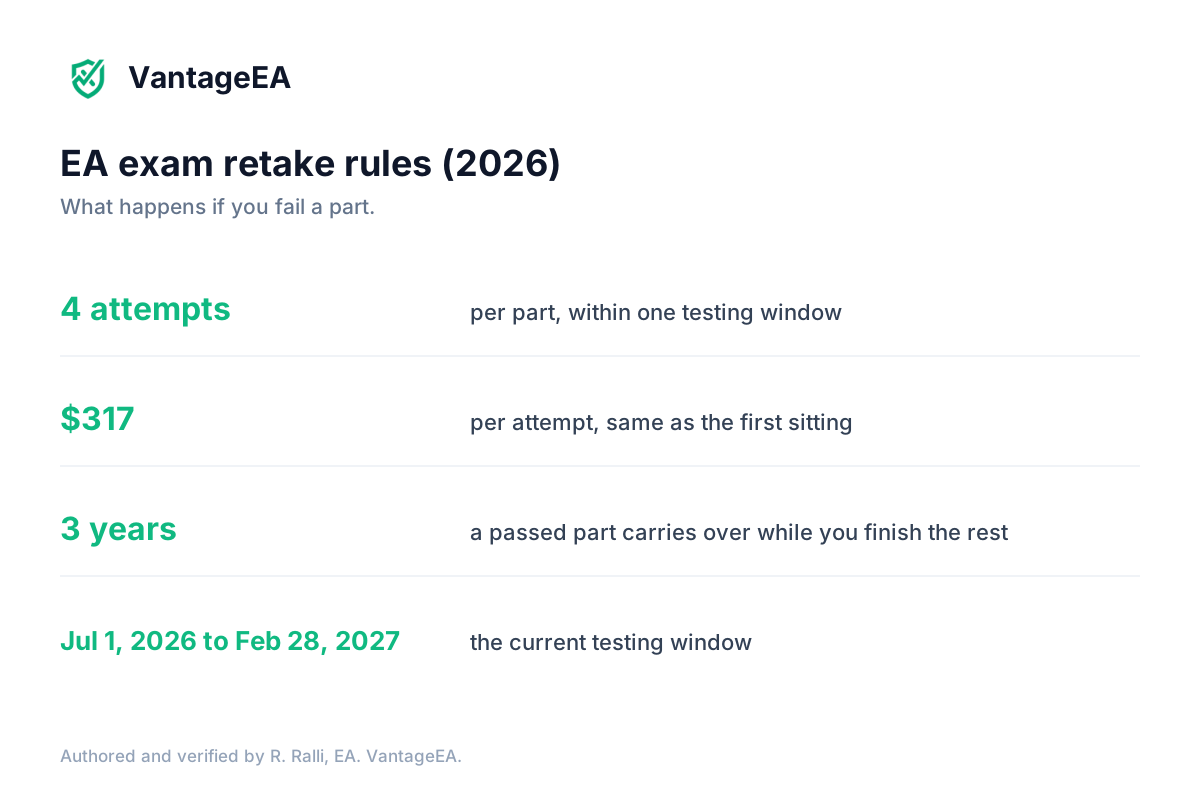
You get up to four attempts on each part within one testing window. The three parts count separately, so spending all four tries on Part 1 leaves your Part 2 and Part 3 attempts untouched.
The window is generally May 1 to end of February. The switch to PSI as the exam administrator changes the dates for the 2026-2027 US window, which runs from July 1, 2026 to February 28, 2027. Each attempt is its own appointment that you book and pay for separately. When a new window opens, the attempt count resets.
- Attempts per part: up to four in a single window.
- Parts are independent: attempts on one never reduce another.
- Reset: the count starts over when a new window opens.
If you are weighing which part to retake first, the sequencing notes in our overview of the enrolled agent exam can help you set the order.
What is the EA exam retake wait time between attempts?
You cannot sit the same part twice in one day. After a failed attempt, you schedule a new appointment through PSI and pay the per-part fee again before you can test.
There is no reward for booking the earliest slot you can find. Use the gap between attempts to fix the specific content areas your score report flagged. Candidates who rush back before addressing their weak spots usually repeat the result and spend the fee for nothing.
- Rebook: schedule a new appointment for the part you did not pass.
- Pay again: the per-part fee applies at scheduling.
- Study first: spend the interval on your weakest areas.
Before you rebook, check the EA exam study schedule so your retake date matches the hours you can realistically commit.
What does it cost to retake a failed EA exam part?
Every retake costs the $317 per-part fee, paid to PSI when you schedule the appointment. There is no discount for repeat attempts, because PSI treats each appointment as a separate exam.
Planning for one retake per part is a reasonable way to avoid a budget surprise. The table shows how the fee adds up across attempts.
| Scenario | Attempts | Total per-part fees |
|---|---|---|
| Pass on first attempt | 1 | $317 |
| Pass on second attempt | 2 | $634 |
| Pass on third attempt | 3 | $951 |
Because each sitting is paid, going in ready keeps the retake from turning into a recurring expense.
Does failing one part affect the parts you already passed?
No. A failed part does nothing to the parts you have already cleared. Each passing score stays valid for three years from the date you earned it.
That three-year credit is what gives you room to recover. As long as you pass all three parts within three years of your earliest passing date, the parts you cleared earlier stay valid while you work on the one you missed. A failed part is a contained problem: you can put all your study time into the single part that remains.
- Independent credit: each passed part is banked on its own.
- Three-year clock: measured from the date you passed each part.
- Deadline: finish all three before your earliest credit expires.
If you have already passed other parts, keep them fresh with the drills on our Part 2 and Part 3 pages while you concentrate on the retake.
How do you read your EA exam score report?
EA scores are reported on a scaled range of 200 to 800, with 500 as the passing mark. A score under 500 is a fail, but the report gives you more than that one number. If your last attempt was under Prometric before July 2026, that score used the old 40 to 130 scale (105 to pass). The IRS has published no conversion between the two, so do not try to map an old score onto the new scale.
A failing score report includes diagnostic information broken down by content area, showing where you were weak and where you were strong. That breakdown is the most useful part of the report, because it tells you where to spend your study time.
- Note your scaled score: see how far you landed from 500.
- Read the area ratings: find the content areas marked weak.
- Set priorities: start with the weakest areas, then shore up the borderline ones.
Line up the weak areas from your report against the domain breakdown on our topics page to turn the diagnostic into a concrete study list.
Why did you fail, and which part is hardest?
Most failing scores trace back to a few under-prepared content areas rather than a broad gap in knowledge. Knowing how the parts compare in difficulty helps you set a realistic target for the retake.
In the 2024-2025 testing year, pass rates were 58% for Part 1 (Individuals), 71% for Part 2 (Businesses) and 70% for Part 3 (Representation), about 66% overall. Those figures are compiled from Prometric score data (the IRS does not publish official pass rates). Part 1 has long been the hardest, so missing it on the first attempt is common and does not mean the exam is beyond you.
| Part | Approximate pass rate | Relative difficulty |
|---|---|---|
| Part 1: Individuals | 58% | Historically hardest |
| Part 2: Businesses | 71% | Broadest content |
| Part 3: Representation | 70% | Most procedural |
For how these numbers shift from year to year, see our breakdown of EA exam pass rates.
How should you build a retake study plan?
Build the plan straight from your diagnostic report. Give the most time to the areas marked weak and the least to what you have already shown you know. This is faster than restudying the whole part from the top.
Working through these stages in order keeps the plan manageable.
- Diagnose: list every weak content area from your score report.
- Prioritize: put your heaviest study blocks against those areas.
- Drill: work topic-specific questions until your accuracy holds steady.
- Simulate: take full-length timed exams to rebuild pacing and stamina.
- Review: go back over every missed question until the reasoning is clear.
Anchor the plan in an EA exam study schedule that fits around your job and family.
When should you schedule your EA exam retake?
Pick a retake date that gives you enough time to close your diagnostic gaps without letting your momentum drain away. Let readiness set the date, even if an earlier slot is open.
Keep the window in view while you choose. The current window closes at the end of February, so leaving the retake to the last few weeks removes any cushion if you need one more attempt.
- Book on readiness: schedule once your timed-practice results land at or above the estimated passing range consistently.
- Watch the window: leave room for another attempt before it closes.
- Hold your momentum: do not leave a gap so long that you have to relearn material.
Once you are clearing full-length simulations regularly, check your readiness against the practice sets on our Part 1 page before you lock in a date.
Can practice exams improve your retake score?
Yes. Timed, full-length practice exams are one of the more reliable ways to lift a retake score, because they train content recall and pacing at once. A candidate who has practiced under the clock is less likely to run out of time or freeze on unfamiliar wording.
Practice questions also surface gaps that a textbook review can hide. Answer actively, review every miss, and passive reading turns into recall you can use on test day.
- Timed simulations: rebuild the stamina and pacing a live exam demands.
- Answer explanations: turn each mistake into a specific fix.
- Progress tracking: confirm your weak areas are actually improving.
You can start at no cost with our free EA practice test and use the results to check the plan you built from your score report.
How does VantageEA support your comeback?
VantageEA is built for this situation: you have a diagnostic report in hand and need to turn it into a passing score. The platform maps your performance to specific content areas, so you do not have to guess where your hours should go.
Rather than restudying everything, you rebuild readiness where it counts. The analytics surface your weak areas, timed practice exams recreate real testing conditions, and accuracy tracking shows whether a weak area has genuinely become a strength before you book a new appointment.
- Analytics: your weak areas are pinpointed and tracked over time.
- Timed exams: full-length simulations rebuild readiness for test day.
- Targeted drills: question sets aligned to each content area on the exam.
See how each area maps to your diagnostic on our topics page.
Next steps for your retake
Plan your retake with VantageEA
The platform reads the weak areas from your score report and rebuilds your readiness with timed, full-length practice exams before your next attempt.
Start your retake plan · Browse exam topics · View plans and pricing