If you prepare taxes, keep books, or want a durable federal credential without going back to college, the enrolled agent question is a fair one to ask before you spend the money and the study hours. This guide gives you an honest read on the return, the career paths it opens, and the people for whom it is genuinely not the right choice.
Is becoming an enrolled agent worth it?
For most working tax preparers and bookkeepers, yes, the enrolled agent credential is worth it. The math is favorable: you invest a few months and roughly one to two thousand dollars, and in return you gain unlimited rights to represent taxpayers before the IRS. That representation authority is the part clients pay a premium for, and it is what separates a credentialed professional from a seasonal preparer.
The honest caveat is that the EA is a federal tax credential. It is not a general accounting license. If your goal is audit, attest, or public-accounting work, the EA will not get you there. So the answer depends on the direction you want your career to move. The sections below break down cost, comparison, and fit so you can decide for yourself. If you want to gauge your starting point first, a free EA practice test is a low-risk way to see how far you have to go.
What is an enrolled agent, and what can the credential do?
An enrolled agent is a tax professional licensed directly by the federal government. The IRS describes the enrolled agent as the highest credential it awards, and the defining benefit is scope of practice.
Here is what the credential grants you:
- Unlimited rights to represent any taxpayer before the IRS, including in audits, collections, and appeals.
- Recognition in all 50 states, because the license is federal rather than issued state by state.
- The ability to represent clients you did not personally prepare returns for.
Unlike many professional paths, there is no college degree required to sit for the exam. You qualify by passing a three-part exam that covers individuals, businesses, and representation, practices, and procedures. If you want the full breakdown of what each part tests, the complete guide to the enrolled agent exam walks through the structure.
What does it cost and how long does it take to earn the EA in 2026?
The cost to earn the EA is modest, which is a large part of why the return holds up. As of 2026, the three exam parts run about $317 each, which comes to roughly $951 in testing fees. Add a PTIN at $19.75, the Form 23 enrollment application, and study materials, and most candidates land somewhere in the range of $1,000 to $2,000 all-in.
Time is the other cost. Many candidates study for a few months and take the parts one at a time. Your pace depends on your existing tax knowledge, so a working preparer may move faster than a career changer.
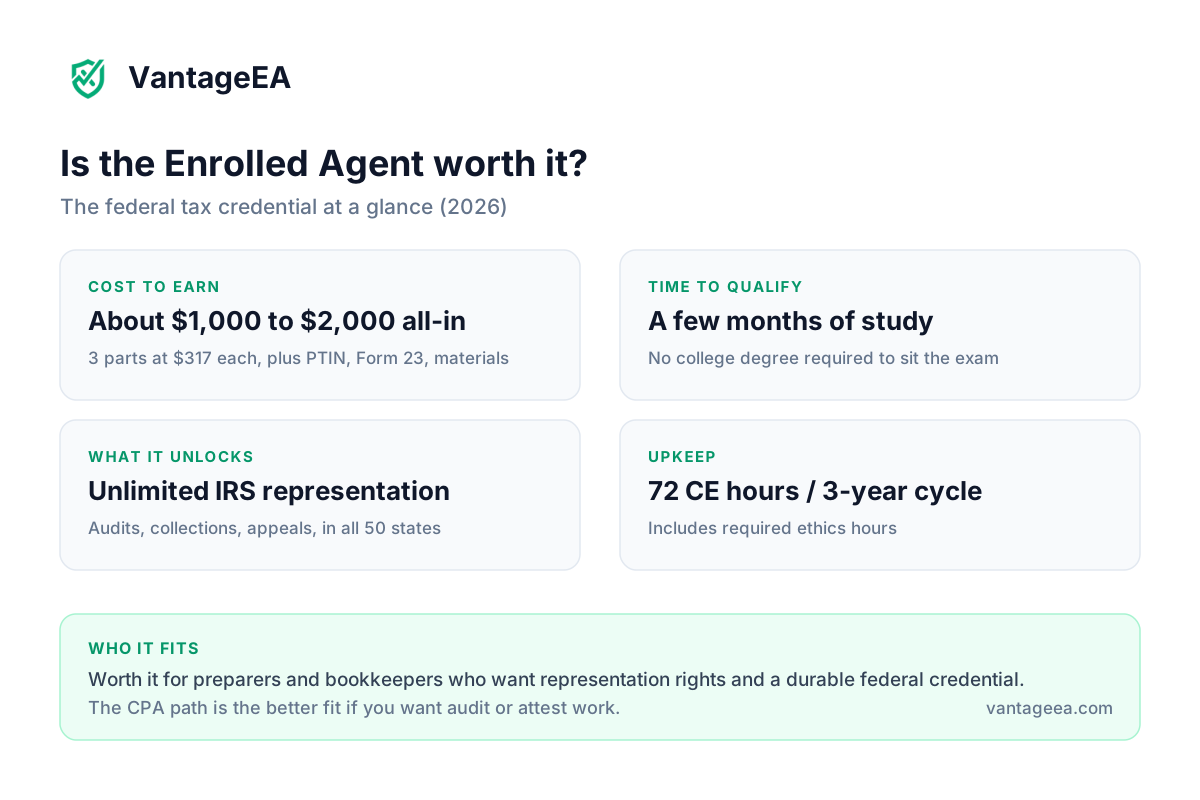
For a step-by-step view of registration, scheduling, and the enrollment paperwork, see the EA exam guide. The takeaway for the worth-it question is simple: the barrier to entry is measured in months and hundreds of dollars, a far lighter lift than the years and tuition bills of a degree.
How does the EA compare with the CPA?
The EA and the CPA are different credentials for different goals, and comparing them on cost alone misses the point. The EA is a focused federal tax and representation license. The CPA is a broader accounting license that also covers audit and attest work. Here is how they line up on the factors that usually drive the decision:
| Factor | Enrolled agent (EA) | Certified public accountant (CPA) |
|---|---|---|
| Education | No college degree required to sit | Typically 150 college credit hours |
| Cost to earn | Roughly $1,000 to $2,000 all-in | Considerably higher, driven by tuition |
| Time | A few months of focused study | Years, including the degree path |
| Scope | Federal tax and unlimited IRS representation | Tax plus audit, attest, and broader accounting |
| Jurisdiction | Federal, valid in all 50 states | Licensed state by state |
Neither one is superior in a vacuum. They answer different questions about what work you want to do. For a fuller side-by-side treatment, read EA vs CPA certification.
Who is the EA worth it for?
The EA pays off most clearly for people who already work in tax and want to expand what they can charge for. If you see yourself in the list below, the credential tends to earn its cost back quickly.
- Tax preparers who want to represent clients in audits and collections rather than hand those cases off.
- Bookkeepers and accounting staff who want a recognized federal credential without a degree requirement.
- Independent preparers who want to move beyond seasonal work and build a year-round practice.
- Career changers who want an entry into professional tax work on a compressed timeline.
For these groups, the representation rights are not a nice-to-have. They are the feature that lets you raise rates and keep clients through the parts of the year when returns are not being filed.
Who is the EA not the best fit for?
The credential is not the right call for everyone, and it is fair to be direct about that. The EA is a tax and representation license, so it does not cover the accounting functions that some careers require.
You should probably look elsewhere if:
- You want to perform audits or attest services, which require the CPA path.
- You are aiming for a public-accounting firm role centered on assurance work.
- You want a broad accounting license rather than a focused federal tax authority.
If any of these describe you, the money and time are better spent on the CPA route. The EA will not substitute for it, and adding it later will not change that.
What return on investment can you expect from the EA?
The return comes from two durable sources: pricing power and steady demand. Representation rights let enrolled agents charge more than seasonal preparers, because the work they can bill for goes beyond filling out a return. Handling a notice, an audit, or a collections case is higher-value work, and clients pay accordingly.
Demand is the second lever. Tax rules keep growing more complex, and that complexity produces a steady flow of taxpayers who need someone credentialed on their side. That backdrop supports year-round work rather than a single busy season.
Reported pay varies widely depending on the source, region, experience, and whether you are employed or independent, so treat any single figure with caution. For a look at the ranges different sources report, see the enrolled agent salary guide for 2026. The reliable point is that the credential is inexpensive to earn relative to the earnings ceiling it removes.
What does the EA career path look like?
The credential opens more than one route, and you do not have to pick a lane on day one. Common paths include:
- Building an independent tax and representation practice with year-round clients.
- Joining a tax firm or preparation chain in a role that requires representation authority.
- Working in-house at a business handling federal tax matters and IRS correspondence.
- Specializing in resolution work such as audits, appeals, and collections cases.
Because the license is federal, your credential travels with you across state lines, which gives you flexibility if you relocate or serve clients remotely. Many enrolled agents also treat the EA as a foundation and layer specializations on top of it over time.
What are the ongoing requirements once you pass?
The EA is not a one-and-done credential, and the upkeep is worth factoring into the worth-it decision. To stay in good standing, you complete 72 hours of continuing education per three-year cycle, and that total must include ethics coursework.
You also renew your PTIN and your enrollment on schedule. None of this is onerous compared with earning the credential in the first place, but it is a real, recurring commitment. The continuing education requirement has an upside as well: it keeps you current as tax rules change, which is exactly the complexity that keeps demand for your services steady.
Is the EA exam worth it in 2026?
The exam is worth sitting if the credential fits your goals, and the way to find out is to test yourself before you commit to full study. The three parts are passable with focused preparation, and the fees are known in advance, so there are few surprises on the cost side.
Before you register, work through a free EA practice test to see where you stand on individuals, businesses, and representation. If you score reasonably well on a diagnostic, the path to passing is short and the return is favorable. If you struggle, you have simply learned where to focus, at no cost. Either outcome makes the decision clearer.
How do you decide if the EA is right for you?
Decide by matching the credential to the work you actually want to do. If you want federal tax authority and the right to represent clients before the IRS, the EA is a fast, affordable, and durable way to get it. If you want audit or attest work, choose the CPA path instead and do not expect the EA to fill that gap.
For most preparers and bookkeepers weighing the two, the EA clears the worth-it bar because the cost is low, the timeline is short, and the representation rights create lasting value. Start with a diagnostic, confirm the fit, and then commit with a clear view of what you are buying.
See where you stand before you commit, with VantageEA
Take a free practice test, review the salary ranges, and start structured prep when you are ready.
Try a free EA practice test · See 2026 EA salary ranges · Create your account