If you are weighing the enrolled agent credential, one question tends to sit at the front of your mind: how much do EAs actually make? The honest answer is that reported enrolled agent salary figures vary widely, and the reason they vary is worth understanding before you build a plan around the credential.
How much do enrolled agents make in 2026?
There is no single authoritative enrolled agent salary, and any source that gives you one clean number is hiding a lot of variation. As of 2026, salary aggregators disagree with each other by tens of thousands of dollars, largely because they measure different populations and different types of pay.
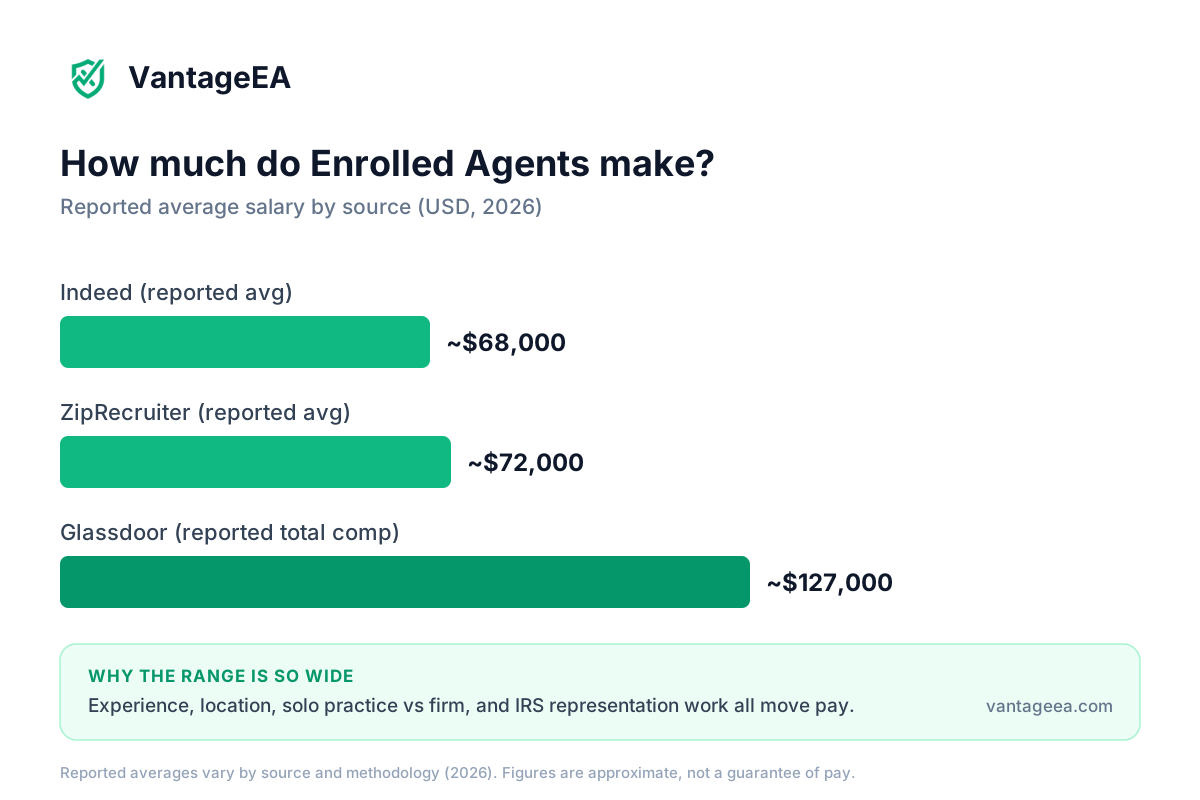
Some aggregators, including Indeed and ZipRecruiter, report averages in roughly the $60,000 to $75,000 range. Glassdoor, by contrast, has reported higher total figures around $120,000 to $130,000 once bonuses and additional pay are folded in. Neither picture is wrong. They simply describe different slices of the profession, and where you land inside that spread depends on choices you make.
What moves your number within that range includes:
- Years of experience and how much of your work is client-facing.
- Whether you work at a firm, in-house, or run your own practice.
- How much IRS representation and controversy work you take on.
- Your location and the local cost of tax services.
- Busy-season overtime and any niche specialization.
Before you treat any one figure as your ceiling, it helps to see why the sources diverge so sharply.
Why do reported EA salaries vary so much by source?
Reported EA salaries vary because each source samples a different group of people and counts pay in a different way. That methodology gap, rather than any real disagreement about the credential, explains most of the distance between a $65,000 headline and a $125,000 headline.
Aggregators that rely on posted job listings tend to capture base salaries for staff-level and seasonal roles, which pulls the average down. Sources that collect self-reported total compensation, including bonuses, capture more senior roles, which pushes the average up. Add the fact that a self-employed EA reports business income rather than a salary, and the picture blurs further.
Common reasons the numbers drift apart include:
- Base pay versus total compensation with bonuses included.
- Job postings, which skew toward entry and mid roles, versus self-reported surveys.
- Employed EAs counted separately from self-employed practitioners.
- Regional mixes that differ between one platform and another.
Once you know what each source is actually measuring, you can read the aggregate tables with a much clearer eye.
What do salary aggregators actually report for EAs?
Aggregators report a spread rather than a point, and reading them side by side is more honest than picking a favorite. The table below shows the direction each source tends to report as of 2026, with the source attributed so you can weigh it yourself.
| Data source | Reported EA pay direction (2026) | What the figure tends to include | Reported by |
|---|---|---|---|
| Job-listing aggregator | Roughly $60,000 to $70,000 average | Base pay for posted roles | Indeed |
| Job-listing aggregator | Roughly $60,000 to $75,000 average | Base pay, wide percentile spread | ZipRecruiter |
| Self-reported survey | Roughly $120,000 to $130,000 total | Base plus bonuses and additional pay | Glassdoor |
Treat these as reported ranges from each named platform. They are unverified, and they shift as each site refreshes its data.
How does EA salary change with experience?
Experience is one of the clearer drivers of enrolled agent pay, and reported figures generally rise as you move from staff work into senior and advisory roles. The credential opens the door, but the years behind it shape the number.
Early-career EAs often sit near the lower end of the reported ranges, especially in seasonal or staff positions. As you take on complex clients, manage relationships, and handle IRS correspondence directly, reported pay tends to climb. Practitioners who reach senior levels, or who own a book of business, appear at the upper end of the surveys.
| Experience level | Reported pay direction | Typical role focus | Reported by |
|---|---|---|---|
| Entry level | Lower end of reported ranges | Return preparation, seasonal support | Aggregator averages, varies by source |
| Mid career | Middle of reported ranges | Client management, notices, some representation | Aggregator averages, varies by source |
| Senior or owner | Upper end of reported ranges | Representation, advisory, practice ownership | Self-reported surveys, varies by source |
The pattern is consistent across sources even when the exact dollars are not: EA salary by experience trends upward, and the steepest gains tend to come from the kind of work only a credentialed representative can do.
What drives higher pay for enrolled agents?
Higher EA pay is driven less by the credential itself and more by how you deploy it. The practitioners at the top of the reported ranges tend to do work that seasonal preparers cannot legally perform.
The single feature that separates an enrolled agent from an uncredentialed seasonal preparer is unlimited representation rights before the IRS. That is a federal authorization, and it is what lets you charge premium fees for audits, appeals, collections, and other controversy work. When you build your services around that ability, your reported income tends to sit well above a preparation-only baseline.
Reported drivers of higher enrolled agent pay include:
- IRS representation and tax controversy engagements.
- Running your own practice and keeping the margin on each client.
- Busy-season overtime and extended engagement hours.
- Specialization in areas such as small-business tax, expatriate returns, or collections.
- Advisory and planning work that recurs year round.
If you want to understand where these fee premiums come from, the representation right is the thread to follow. In practice that right is exercised through a power of attorney, covered in the Form 2848 vs Form 8821 explainer.
Does IRS representation work increase what you can charge?
Yes, representation work is the clearest lever for higher earnings, because it is priced as expertise rather than as a per-return task. This is the practical reason the EA credential can command more than seasonal preparation.
A seasonal preparer without credentials is limited once a return is filed and a notice arrives. An enrolled agent can step in, communicate with the IRS on the client's behalf, and carry a matter through audit or appeal. Clients pay for that authority hourly or by engagement rather than by the form. To reach that work, you first have to pass the Special Enrollment Examination, and you can gauge your readiness with a free EA practice test before you commit to a study plan.
Representation work tends to pay well because it is:
- Authorized only for credentialed representatives, which limits supply.
- Higher stakes for the client, which supports higher fees.
- Often billed hourly rather than as a flat per-return charge.
- Recurring, since tax matters can span multiple years.
That premium is why the same credential can look like a modest salary in one dataset and a strong income in another.
How does where you work affect your EA salary?
Where you work shapes your enrolled agent salary as much as your experience does, because a paycheck and a practice generate income in different ways. The employment model you choose sets the shape of your earnings.
Employed EAs at firms, tax-prep chains, or corporate tax departments earn a salary that the job-listing aggregators capture directly. Self-employed EAs earn business income that depends on client volume, fee structure, and overhead, and that income does not show up cleanly in salary surveys. Both paths can land in the higher reported ranges, but they get there through different math.
- Firm or corporate roles: steadier salary, benefits, and defined hours.
- Tax-prep chains: often seasonal, with pay weighted to the filing season.
- Solo or small practice: income tied to your fees, client base, and margins.
Deciding between a paycheck and a practice is one of the most consequential choices for your long-run EA income, and it interacts closely with location.
How does location affect enrolled agent pay?
Location affects EA pay because both wages and the local price of tax services vary by region. Reported averages in high-cost metropolitan areas tend to run above rural or lower-cost markets, though the gap narrows once you adjust for expenses.
Rather than quote precise state-by-state figures, which shift constantly and differ by source, it is safer to reason about the factors. Areas with dense small-business activity, higher living costs, and more complex tax situations generally support higher fees and higher reported salaries. Lower-cost regions may show smaller headline numbers while offering similar purchasing power.
Location factors worth weighing include:
- Regional wage levels and cost of living.
- Local demand for representation and business tax work.
- Competition from other credentialed practitioners.
- Remote work, which lets some EAs serve clients outside their local market.
Because location interacts with setting and experience, the most reliable way to estimate your own number is to model your specific situation rather than lean on a national average.
Is the EA a good career for the pay?
For many people the EA is a strong value proposition on pay, mainly because the cost and time to earn it are modest relative to the earning paths it opens. Whether it is a good career for the pay depends on how you intend to use the credential.
The credential is federal, portable across state lines, and focused entirely on tax. If your goal is representation work, a specialized practice, or a defined role in a firm's tax function, the reported ranges suggest a solid return on a relatively short path. If you weigh it against a broader accounting credential, the tradeoffs are different, which is worth thinking through in our look at whether becoming an enrolled agent is worth it in 2026.
- Lower time and cost to earn than many alternative credentials.
- Federal scope, so you are not tied to one state.
- Clear route to premium representation fees.
- Flexibility to work employed, seasonally, or independently.
If the numbers make sense for your goals, the next question is how the EA stacks up against the credential it is most often compared with.
How does EA pay compare with becoming a CPA?
EA and CPA pay overlap heavily, and the better framing is scope rather than a raw salary contest. CPAs cover a broad accounting and audit remit, while EAs concentrate on tax and IRS representation, and pay reflects the work each does rather than the letters alone.
A CPA path usually requires more education, a longer exam, and state licensure, which can support higher pay in audit and advisory roles. An EA path is faster and tax-focused, and a tax-specialized EA can match or exceed a generalist accountant's pay within that niche. Our side-by-side on EA versus CPA certification walks through the tradeoffs in detail.
- CPA: broader scope, longer path, state-licensed.
- EA: tax-focused, faster to earn, federally recognized.
- Pay overlaps, with the split driven by specialization and setting.
Once you have chosen the EA path, the last step is turning the credential into income.
How can you start earning as an enrolled agent?
You start earning as an EA by passing the three-part Special Enrollment Examination and then applying the representation rights it grants. The credential is the gate, and the exam is the work that gets you through it.
A practical sequence is to learn the exam structure, study each of the three parts, and test your readiness before you schedule. Our EA exam guide lays out the parts and the process, and the full guide to the enrolled agent exam goes deeper on content. When you are ready to check where you stand, a free EA practice test gives you a quick read on your weak areas.
- Understand the three parts of the exam and how they are scored.
- Build a study plan around your weakest sections.
- Practice with realistic questions before you book a testing slot.
- Decide early whether you will work at a firm or build a practice.
The pay follows the work, and the work starts with passing the exam and putting your representation rights to use.
See where your EA earnings could start with VantageEA
Test your readiness for the enrolled agent exam and turn the credential into income.
Take a free EA practice test · Compare EA and CPA · Create your free account