The Enrolled Agent exam, formally the Special Enrollment Examination (SEE), is structured differently from most professional certification exams. This guide walks through that structure so you know what to expect on test day with PSI, whether you test remotely or at a test center. For the wider process, see our full EA exam guide.
How Many Questions Are on the EA Exam?
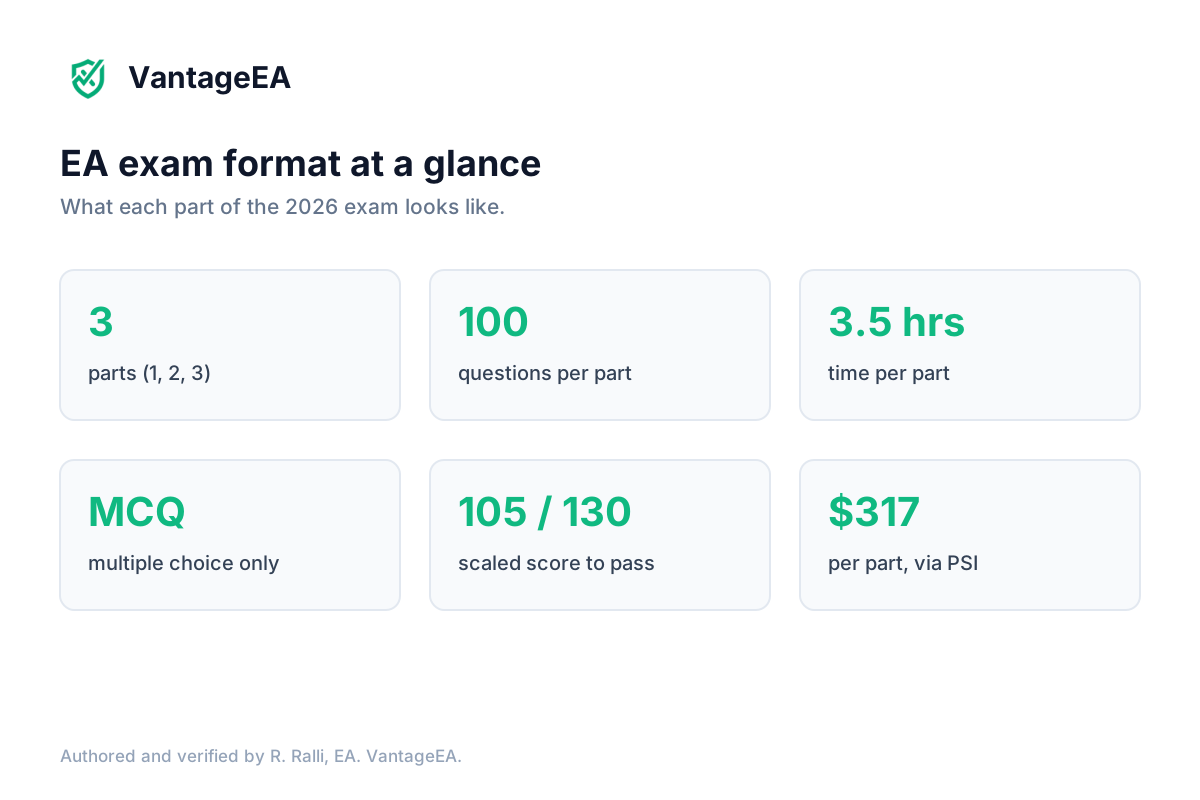
Each part of the exam has exactly 100 questions. The exam is split into three parts, and you sit each one as its own session:
- Part 1: Individuals covers individual taxation, from filing status to tax credits.
- Part 2: Businesses covers business taxation, from C corporation formation to the QBI deduction.
- Part 3: Representation, Practices, and Procedures covers Circular 230 and the IRS appeals process.
That comes to 300 questions across the three parts, but not all of them count. About 85 of the 100 on each part are scored; the other 15 are pretest (experimental) questions the IRS uses to develop future exams. You won't know which is which, so treat every question as if it counts.
What Types of Questions Appear on the EA Exam?
The exam uses two question types: multiple-choice questions (MCQs) and task-based simulations (TBS). Most questions are standard MCQs, though recent testing cycles have added TBS to check practical application.
Multiple-choice questions (MCQs)
Most questions are standard multiple choice with four options (A, B, C, D), and only one is correct. They test your knowledge of tax law and IRS procedures, and how you apply the rules to a specific situation. Common formats include:
- Direct knowledge, such as "What is the standard deduction for a single filer in tax year 2025?"
- Scenario-based, such as "John is a self-employed contractor who earned $95,000 and paid $12,000 in health insurance premiums. How much can he deduct on Schedule 1?"
- Rule application, such as "Under Circular 230, which of the following actions would be a violation?"
Task-based simulations (TBS)
Recent testing cycles have added a small number of task-based simulations to the SEE. These are more interactive and may ask you to:
- Complete part of a tax form, such as Schedule C or Form 1040
- Match items to categories, for example expenses to the correct deduction category
- Identify the correct entries from a set of options
- Analyze a scenario and select more than one correct response
TBS questions test practical application rather than rote memorization, and they carry the same weight as MCQs. Being comfortable with both formats is part of reaching a passing score.
How Much Time Do You Have for Each EA Exam Part?
Each part has a 3.5-hour (210-minute) time limit, which works out to roughly 2 minutes and 6 seconds per question. A 15-minute introductory tutorial at the start and a short survey at the end are both optional and don't count against your exam time.
Pacing matters. One approach that works for many candidates:
- First pass, about 120 minutes: go through all 100 questions, answer the ones you know, and flag the rest. Aim for roughly a minute each.
- Second pass, about 60 minutes: return to the flagged questions and work through them, spending up to three or four minutes on the harder ones.
- Review, about 30 minutes: check your answers, verify calculations, and reread anything with qualifying words.
The PSI software shows a timer on screen and has a "mark for review" feature for flagging questions. Practice the pacing with VantageEA's timed practice exams so test day feels familiar, and build the habit into a structured study schedule.
How Is the EA Exam Scored?
The exam uses a scaled scoring system that runs from 200 to 800, with a passing score of 500. A score of 500 or higher passes; anything below fails. The scaled score is not a percentage. The IRS counts the questions you answer correctly and converts that number to the 200 to 800 scale, which adjusts for differences in difficulty across exam versions. This scale arrived with the move to PSI. Before July 2026, under Prometric, scores ran from 40 to 130 with 105 to pass, and the IRS has published no conversion between the two scales.
The IRS doesn't publish the number of correct answers needed to reach 500, because it depends on the difficulty of the set you get, and it has not published a percentage equivalent. Treat any fixed percentage you see quoted as a guess. Current pass rates run around 58 to 71% across the three parts, with Part 1 the lowest.
In practice, two candidates who answer the same number of questions correctly can end up with slightly different scaled scores if their exam versions differed in difficulty. The system is built for fairness across versions rather than a fixed raw cutoff, so there's no single percentage you can count on hitting.
Under PSI, the testing workstation shows only Pass or Fail when you finish. Your full score report, with your scaled score, arrives by email. A failing report also breaks down your performance by topic area, which helps you target your studying for a retake.
What Is the EA Exam Testing Environment Like Under PSI?
US candidates can test remotely through PSI online proctoring (from home, school, or office, in a walled room where you will not be disturbed) or at a PSI test center. International scheduling and testing is temporarily delayed by the IRS, with no new date announced yet. Check-in and security follow PSI's standard rules either way, so knowing what to expect helps cut down on nerves. Our EA exam day guide compares the two options in detail.
Before the exam
- At a test center, arrive early for check-in with a valid, government-issued photo ID.
- For a remote appointment, log in early and set up in an enclosed, walled room where you will not be disturbed, with good lighting and no one else present.
- At a center, personal items go in a locker, including phones, watches, food, notes, and study materials. Remotely, clear your desk of the same items.
- You can't bring your own calculator, scratch paper, or reference materials.
During the exam
- A proctor monitors you the whole time, in the testing room or through your webcam.
- An on-screen scratchpad replaces physical scratch paper.
- An on-screen calculator is available; physical calculators aren't allowed.
- The exam is split into three sections with two optional 10-minute breaks between them.
After the exam
- The workstation shows Pass or Fail on the spot; your full score report with your scaled score arrives by email.
- Once you pass all three parts, you can file the enrollment application (Form 23, which costs $140).
- You'll also need a PTIN (Preparer Tax Identification Number), which costs $19.75 per year.
When Can You Take the EA Exam?
The testing window is generally May 1 to end of February, with a blackout in March and April while content is updated for new tax law. The current US window runs July 1, 2026 to February 28, 2027, because the move to PSI pushed the 2026 start back from May 1. International scheduling and testing is temporarily delayed by the IRS, with no new date announced yet.
During the testing window, you can book any available PSI appointment, remote or at a test center, on a date and time that suit you. Popular slots such as Saturday mornings and weekday evenings fill up fast, so book several weeks ahead. You pay the $317 per-part fee when you schedule, and you can book all three parts at once or space them out around your study schedule.
Each part you pass carries over for up to 3 years from the date you pass it. Plan your testing so you pass the remaining parts before your earliest pass expires.
What Happens If You Fail a Part?
If you don't pass a part, you can retake it by scheduling a new appointment with PSI. A failed attempt affects only that part; you can keep testing the other parts you haven't passed yet in the meantime.
You can attempt each part up to 4 times per testing window, and each retake means paying the full $317 exam fee again. The count resets when a new window opens, and the carryover rule still applies: each passed part stays valid for up to 3 years from the date you pass it, so finish the rest before your earliest pass expires. Our EA exam retake rules post covers the details.
Your score report diagnostics are worth using. The breakdown shows which content areas gave you trouble, so you can concentrate your review there. Plenty of candidates who miss on the first attempt pass on the second after focused study.
How Should You Prepare for the EA Exam Format?
A few habits make the format itself easier to handle:
- Practice with timed exams to get used to the roughly two-minutes-per-question pace. VantageEA's platform runs timed tests that mirror the real exam.
- Get comfortable with a basic on-screen calculator, since physical ones aren't allowed.
- Use the flag-and-review approach. Don't spend more than three minutes on any one question in your first pass; flag it and move on.
- Study the parts in an order that suits you. Many candidates start with Part 1 (Individuals) for the familiar material, then Part 2 (Businesses), and finish with Part 3 (Representation); others take Part 3 first because it has the least tax law.
- Read questions closely. Qualifying words like "except," "not," "always," or "never" can flip the answer, so note them on your scratch paper.
- Practice task-based simulations too. Make sure your study materials include TBS so the interactive format isn't new to you on the day.
- Take at least two or three full-length practice exams (100 questions, 3.5 hours) under timed conditions before your test date.
Ready to Practice with Real Exam-Style Questions?
Get exam-ready with VantageEA
VantageEA offers practice questions in the same format as the real EA exam. The timed practice tests mirror the PSI setup, and every question comes with a detailed explanation and references to IRS publications.
Start practicing for free with no credit card required, or browse the full topic coverage for all three parts. See the pricing plans for unlimited access to the question bank and study tools.
Many candidates use VantageEA to prepare for the exam. Our study methods and practice questions help you work toward the passing score of 500.