Exam day rules changed when PSI took over the Special Enrollment Examination. As of March 1, 2026, the EA exam is administered by PSI, and how you sit each part now depends on where you are and which delivery method you choose. This page walks you through what to expect on EA exam day in 2026, how a PSI test center compares with remote online proctoring, what you can bring, and how breaks and scoring work. Before you book, you can also warm up with a free EA practice test so the format feels familiar.
What is changing for EA exam day under PSI in 2026?
The examiner behind the EA exam is now PSI. According to PSI and the IRS, the transition took effect on March 1, 2026, and it affects both scheduling and the mechanics of test day.
The most visible change for candidates in the United States is choice of venue. You can sit a part at a PSI test center or take it through remote online proctoring from your own location. International scheduling and testing is temporarily delayed by the IRS, with no new date announced yet. The United States testing window runs from July 1, 2026 to February 28, 2027, and each of the three parts carries a fee of $317.
- PSI administers the EA exam as of March 1, 2026.
- United States candidates choose between a test center and remote online proctoring.
- International scheduling and testing is temporarily delayed by the IRS, with no new date announced yet.
- The United States window covers July 1, 2026 to February 28, 2027.
If you sat a part earlier under the previous vendor and want context on the handover, the change is covered in more detail in the Prometric to PSI transition breakdown.
Can you take the EA exam at home in 2026?
Yes. If you are a United States candidate, you can take the EA exam at home or in another private location through remote online proctoring, rather than traveling to a test center.
Remote delivery puts the responsibility for the testing environment on you. You supply an enclosed, walled room with good lighting, and you test alone with no other people or pets present. A proctor observes you through your webcam for the whole appointment, so you stay within the camera view and follow the same conduct rules that apply inside a center. Before questions begin, PSI runs a room and equipment check to confirm your setup is acceptable.
Remote testing suits you if you have a quiet, private space and reliable equipment. If your home is shared, noisy, or short on a room you can seal off, a test center may be the calmer option.
What is the difference between remote and test center for the EA exam?
The exam content is identical either way. What differs is the environment, the check-in, and who controls the room. The table below sets the two side by side on the points candidates ask about most.
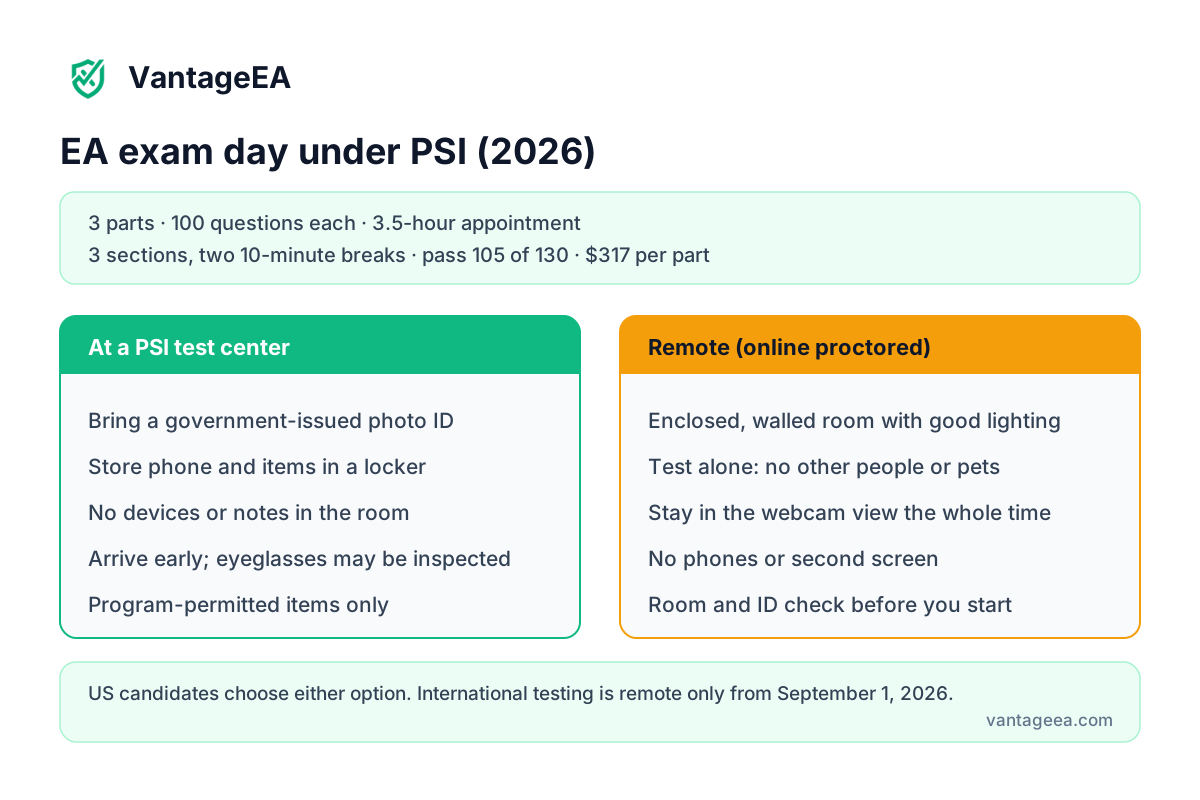
| Point | PSI test center | Remote online proctored |
|---|---|---|
| Environment | PSI provides the room, seat, and screen. You arrive early and check in. | You provide an enclosed, walled room with good lighting and test alone, with no other people or pets. |
| Identification | A valid government-issued photo ID is checked at the desk. | A valid government-issued photo ID is verified on camera during the pre-exam check. |
| Breaks | Two scheduled 10-minute breaks within the 3.5-hour appointment. | Two scheduled 10-minute breaks; you stay within the rules while the session pauses. |
| What to bring | Only your photo ID. Personal items go into secure storage or a locker. | Nothing extra at your desk: no phones, no second screen, no notes. |
For a deeper look at how observation and integrity checks work across both methods, see how proctoring works.
What should you bring to the EA exam?
At a test center, bring one thing above all: a valid government-issued photo ID. Everything else stays out of the testing room.
PSI does not allow personal items in the room. Centers provide lockers or secure storage for keys, a wallet, and a phone, and you retrieve them when you leave or during a break, subject to the center rules. Eyeglasses may be inspected before you are seated. For a remote appointment, the equivalent of what to bring is what you clear away: your desk should hold only your permitted equipment, with phones, notes, and any second screen removed.
- Valid government-issued photo ID, with the name matching your registration.
- No phones, smart watches, or personal devices in the room.
- Keys, wallet, and bags stored in lockers or secure storage at a center.
- Eyeglasses may be inspected before you begin.
Names and ID requirements can be updated over time, so confirm current details in the PSI Candidate Information Bulletin before you travel or connect.
What are the rules at a PSI test center?
Plan to arrive early, check in with your photo ID, and store your belongings before you are seated. From there, standard testing conduct applies for the whole appointment.
You cannot bring personal items or devices to your seat, and phones stay in storage. The proctor supervises the room, and the timer runs on the schedule set for your part. If you wear glasses, expect a quick inspection at check-in. Treat the arrival buffer seriously, because late arrival can cost you the appointment.
- Arrive early and complete check-in with a valid photo ID.
- Place keys, wallet, and phone in the locker or secure storage provided.
- Keep no devices or personal items at your seat.
- Follow the proctor instructions for breaks and departures.
What are the rules for remote online proctoring?
For a remote appointment, you must create a controlled space and stay visible and silent to the camera for the full session. The proctor can flag or terminate the session if the rules are broken.
PSI expects an enclosed, walled room with good lighting where you test alone, with no other people and no pets. You stay within the webcam view, use no phones or second screens, and do not talk or read aloud, because speaking can be flagged. A room and equipment check runs before you start, so allow time for it. If you are unsure whether reading a question quietly to yourself is allowed, the specifics are addressed in this guide to talking during PSI proctoring.
- Test in an enclosed, walled room with good lighting.
- Be alone, with no other people or pets in the room.
- Stay within the webcam view for the whole session.
- Use no phones or second screens, and do not talk or read aloud.
- Complete the room and equipment check before questions begin.
How do EA exam breaks work in 2026?
Each part now includes two scheduled 10-minute breaks. PSI delivers the exam in three sections, and the breaks fall between those sections within the 3.5-hour appointment.
Because the breaks are scheduled rather than optional pauses you take whenever you like, plan around them. Use the time to rest your eyes, stretch, and reset your focus, then return to your seat or your camera view promptly. At a center you may access stored items subject to the center rules; remotely you stay within the proctoring rules while the section timer pauses. This structure is one reason the newer format feels different from older single-block sittings.
What is the EA exam format and scoring?
Each of the three parts has 100 multiple-choice questions, delivered in three sections during a 3.5-hour appointment. Scoring runs on a scaled range, and the bar to pass is fixed.
Your result is reported as a scaled score from 200 to 800, and a scaled score of 500 is the passing mark. The three parts cover the standard EA domains, and you can take them in any order across the testing window. For a fuller look at question types and how the sections are laid out, see the EA exam format and questions guide.
- Three parts, each with 100 multiple-choice questions.
- A 3.5-hour appointment delivered in three sections.
- Two scheduled 10-minute breaks per part.
- Scaled score from 200 to 800; 500 is passing.
- Fee of $317 per part.
What can you expect on EA exam day?
Expect a check-in step, a controlled environment, timed sections with two short breaks, and a clear set of conduct rules that hold from start to finish. The rhythm is the same whether you test at a center or remotely, even though the setting differs.
At a center, you arrive early, present your photo ID, store your belongings, and take your seat. Remotely, you complete the room and equipment check, verify your ID on camera, and begin once the proctor clears your setup. During the exam you work through the sections, pause for the scheduled breaks, and stay within the rules for the full appointment. Knowing this sequence in advance removes most of the day-of surprises.
If you want the full picture of eligibility, scheduling, and preparation in one place, the EA exam guide ties the pieces together.
How should you prepare for EA exam day?
Prepare for the content and the conditions. Study the material, then rehearse the timing and the environment so that neither feels new when you sit down.
Book your part inside the United States window, decide early whether a center or a remote appointment fits your space, and read the current rules so your ID and setup are correct. Practicing under timed conditions helps you gauge pacing across the three sections and the two breaks. You can run repeated timed sets with a free EA practice test to build that pacing before the real appointment. Wherever the bulletin and this page differ, confirm current details in the PSI Candidate Information Bulletin, since PSI can update specifics during the window.
- Book within the July 1, 2026 to February 28, 2027 United States window.
- Choose test center or remote based on your available space.
- Confirm your photo ID meets the current requirement.
- Rehearse timing across three sections and two breaks.
Get ready for PSI exam day with VantageEA
Practice the format, pacing, and rules so exam day feels like a rehearsal you have already run.
Take a free EA practice test · See how we proctor · Create your account