If you are preparing for the Special Enrollment Examination (SEE), you have probably heard that the exam moved to a new proctoring provider. As of March 1, 2026, the EA exam is administered by PSI Services, which replaced Prometric. PSI offers both test-center and remote online proctoring for US candidates, and remote proctoring watches you closely through your webcam. A common worry follows naturally: if you talk to yourself, read a question under your breath, or glance away from the screen, can you get flagged? This guide walks through PSI's published proctoring rules, what actually triggers a warning versus a terminated exam, and the habits that keep your session clean from start to finish.
Can you talk during the EA exam?
No. According to PSI's proctoring guidance, talking aloud to yourself is one of the behaviors that can generate a warning or trigger exam termination during a remotely proctored session. The rule applies at any volume, because the proctor needs to confirm that you are working alone and not receiving help.
Remote proctoring uses your microphone and camera to monitor the whole appointment. When you speak, even quietly, the system and the human proctor cannot immediately tell whether you are reading to yourself or communicating with someone off camera. To stay on the safe side, treat the exam as a silent activity from the moment your session starts until it ends.
- Read every question silently, in your head.
- Do not narrate your reasoning out loud.
- Do not answer questions from anyone in your home during the appointment.
If you are used to studying while talking through problems, that habit needs to be unlearned before test day. You can rehearse silent test-taking during a free EA practice test so the quiet room feels normal rather than restrictive.
What behaviors does PSI flag during online proctoring?
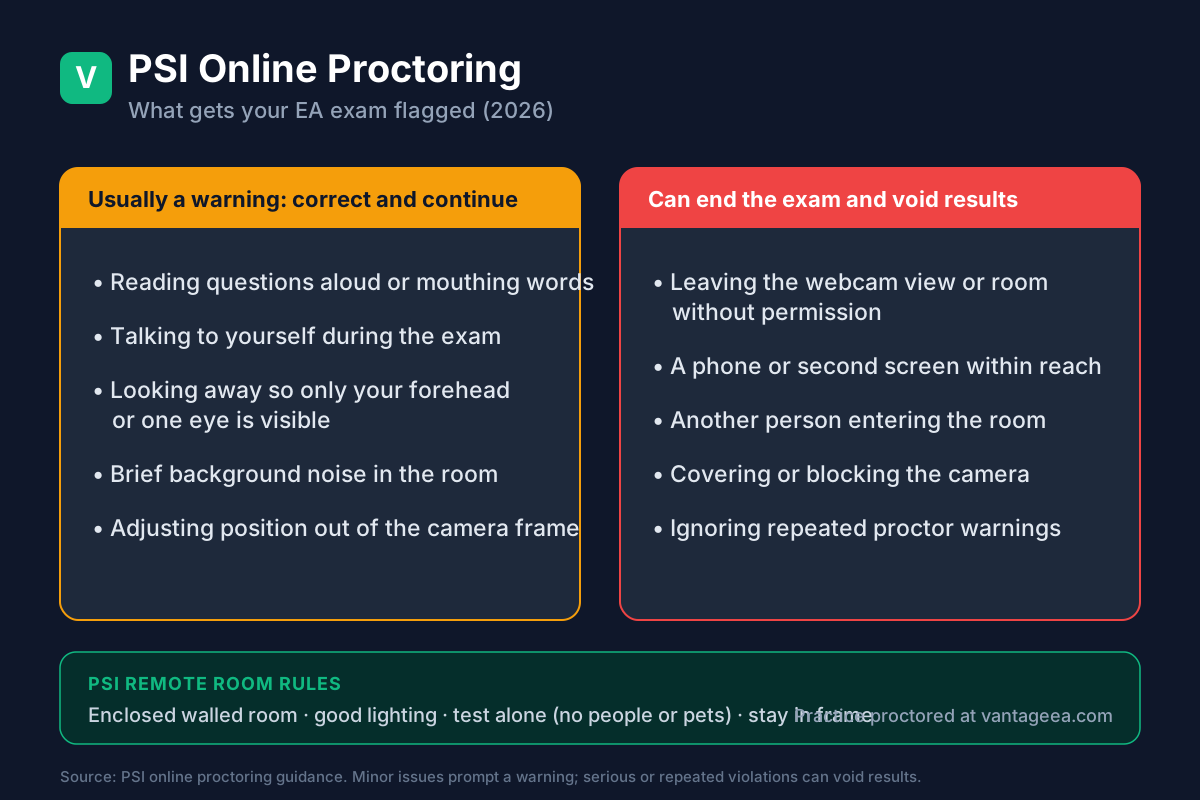
PSI publishes a clear list of behaviors that its online proctoring monitors for. Each one is something a proctor can see or hear through your webcam and microphone, and each one either generates a warning or, in serious or repeated cases, triggers termination of the exam.
According to PSI's proctoring guidance, the flagged behaviors include the following:
- Talking aloud to yourself or reading questions aloud.
- Mouthing words, even without sound.
- Interacting with another person in the room.
- Looking away from the camera, for example when only your forehead or one eye is visible.
- Covering the camera.
- Leaving the room or the webcam view without permission.
- Using unauthorized devices such as a phone or a second screen.
- Displaying prohibited materials.
Notice how many of these come down to two themes: staying visible and staying silent. Knowing the list in advance is the first step, because most flags happen when a candidate does something out of habit rather than out of intent to cheat.
Does reading questions aloud get you flagged by PSI?
Yes. Reading questions aloud is explicitly named in PSI's proctoring guidance as a behavior that can generate a warning or trigger termination. Many candidates read aloud without realizing it, especially when a question is long or the answer choices look similar.
The reason PSI treats this seriously is straightforward. Reading a question aloud could be a way of feeding exam content to another person, and the proctor cannot verify your intent in real time. The safer approach is to build a silent reading habit long before your appointment.
Silent reading strategies for dense tax questions
- Use your eyes to track the line you are on rather than your voice.
- Re-read the stem in your head if it is complex, instead of whispering it.
- Take mental notes rather than muttering key figures.
If reading aloud is a deep habit, practice against realistic conditions using the free EA practice test until silent reading is automatic.
Can you mumble or mouth words during a proctored exam?
No. PSI's proctoring guidance lists both talking aloud and mouthing words as monitored behaviors. Mouthing words silently still counts, because the camera can see your lips move and the proctor cannot rule out that you are communicating with someone off screen.
This is one of the most surprising rules for candidates, since mouthing feels harmless and often happens subconsciously during concentration. The key point is that PSI monitors what it can observe, and lip movement is observable. Being aware of the habit is usually enough to control it.
- Keep your jaw relaxed and closed while you read.
- If you catch yourself mouthing words, pause, reset, and read silently.
- Avoid resting your hand over your mouth, which can look like an attempt to hide speech.
For a full picture of what to expect on exam day, review the EA exam guide before you schedule your appointment.
What are PSI's remote testing environment rules?
PSI requires a controlled physical space for remote proctoring, and your environment is checked before the exam begins. According to PSI's guidance, your testing space must meet several conditions throughout the appointment.
The remote environment rules include the following:
- An enclosed, walled room where you test alone.
- Adequate lighting so the camera can see you clearly.
- No one else entering the room, including children and pets.
- Staying within the webcam view at all times.
- Only program-permitted items within reach.
These rules protect the integrity of your result, but they also protect you. A clear, well-lit, private room removes most of the situations that lead to a flag. To see how a proctored session is set up in practice, look at how we proctor practice exams.
What is the difference between a warning and a termination?
PSI proctoring uses two levels of response. Minor issues get a proctor warning, and serious or repeated violations lead to termination and results being voided. Understanding the difference helps you react calmly if a proctor speaks to you mid-exam.
A warning is a signal to correct something, for example moving back into frame or stopping a distracting behavior. A termination ends the appointment. The table below maps common flagged behaviors to their typical consequence based on PSI's guidance.
| Flagged behavior | Typical consequence |
|---|---|
| Looking away from the camera briefly | Warning |
| Mouthing words while reading | Warning, escalating if repeated |
| Talking aloud or reading questions aloud | Warning, escalating to termination |
| Another person entering the room | Warning to termination, depending on interaction |
| Covering the camera | Termination |
| Leaving the webcam view without permission | Termination |
| Using a phone or second screen | Termination and voided results |
| Displaying prohibited materials | Termination and voided results |
The pattern is consistent: behaviors that could be innocent tend to start with a warning, while behaviors that clearly break integrity rules lead straight to termination.
Why would PSI void your exam results?
PSI voids results when a violation is serious enough, or repeated enough, that the integrity of the session can no longer be confirmed. A voided result means the exam does not count, and the outcome is treated as though the test was not validly completed.
This is why the flagged behaviors matter beyond a single warning. According to PSI's guidance, serious or repeated violations lead to termination and voided results, so a pattern of small slips can add up. The best protection is prevention.
Common paths to a voided result
- Repeated warnings for the same behavior after being asked to stop.
- Introducing an unauthorized device into the session.
- Allowing another person to participate in any way.
If you are worried about what happens after a terminated attempt, the EA exam retake rules for 2026 explain how re-scheduling works.
How can you avoid getting flagged by PSI?
You avoid getting flagged by making the correct behaviors automatic before exam day rather than trying to remember them under pressure. Most flags come from habits, so the fix is to change the habits themselves.
Use this checklist as you prepare and again on the day of your appointment:
- Test in an enclosed, private room with good lighting.
- Clear the room of other people, pets, phones, and notes.
- Position your camera so your whole face stays in frame.
- Read silently, without whispering or mouthing words.
- Keep your eyes on the screen and avoid looking away for long.
- Do not leave the webcam view without asking the proctor first.
The single most effective step is rehearsal. When you practice under conditions that mirror the real proctor, the rules stop feeling like restrictions and start feeling like your normal routine. You can build that routine with a free EA practice test taken under webcam monitoring.
When does PSI proctoring apply to the SEE?
PSI proctoring applies to the SEE for the current testing window, which runs from July 1, 2026 to February 28, 2027 for US candidates. PSI took over administration from Prometric on March 1, 2026 and offers both test-center and remote online proctoring in the US.
International candidates should note a separate detail: International scheduling and testing is temporarily delayed by the IRS, with no new date announced yet. Whether you test at a center or from home, the proctoring standards described in PSI's guidance apply to your session.
- US test window: July 1, 2026 to February 28, 2027.
- US options: test center or remote online proctoring.
- International: Temporarily delayed by the IRS, no new date announced yet.
For a deeper look at what changed in the transition, read our overview of the EA exam move from Prometric to PSI in 2026.
Is the EA exam itself changing under PSI?
Mostly no. The provider changed, but the structure of the exam did not. The SEE still has three parts, and each part has 100 multiple-choice questions delivered in a 3.5-hour appointment.
Scoring did change. Each part is now reported on a scaled score from 200 to 800, and 500 is the passing score. Before July 2026, under Prometric, the scale ran from 40 to 130 with 105 to pass, and the IRS has published no conversion between the two. The fee is $317 per part.
| Exam element | Detail |
|---|---|
| Parts | Three |
| Questions per part | 100 multiple-choice |
| Appointment length | 3.5 hours |
| Scaled score range | 200 to 800 |
| Passing score | 500 |
| Fee per part | $317 |
If you want the full breakdown of how the questions are built and scored, see our guide to the EA exam format and questions.
Should you practice under proctored conditions before exam day?
Yes. You cannot rehearse proctoring on a static question bank, so practicing under realistic webcam proctoring is the most reliable way to prepare for how PSI monitors your session. The exam content is one challenge. The proctored environment is a separate skill, and it rewards practice.
Rehearsal builds the exact habits PSI expects: stay in frame, do not read aloud, keep the room clear, and stay silent while you work. When those habits are already in place, PSI's monitoring is not a surprise, and you can spend your attention on the tax questions rather than on the camera.
- Lite Proctoring and Strict proctoring practice are available today.
- Practice sessions use your webcam, mirroring the real setup.
- Repeated practice turns the rules into routine.
See exactly how the setup works on the how we proctor page, then run a session with the free EA practice test to feel the difference before your real appointment.
Rehearse PSI proctoring with VantageEA before exam day
Practice under realistic webcam proctoring so PSI's monitoring feels routine on test day.
Start a free practice test · See how we proctor · Create your account